
When War Looks Like Bad Design: an Unusual Starting Point
Imagine war as a product launch. Boards meet, budgets are drawn, marketing promises decisive results and the public — customers in this metaphor — are asked to buy in with their taxes and sons and daughters. Some launches succeed; others are catastrophic flops. The concept of “poor quality war” treats armed conflict as an enterprise that can be poorly specified, badly managed and dangerously sold. This reframing lets us apply familiar quality-control instincts to something normally discussed in moral absolutes.
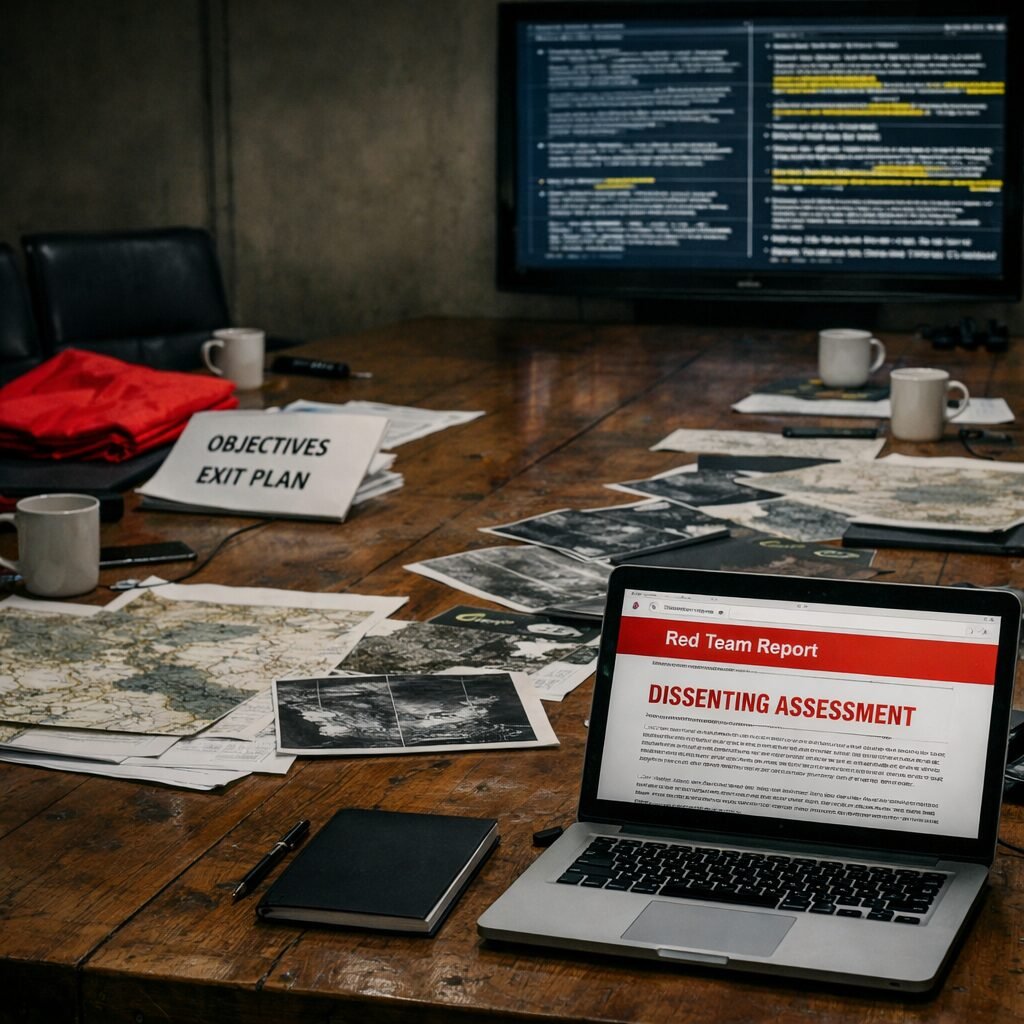
Thinking in terms of quality exposes avoidable faults: fuzzy aims, absent testing, no contingency planning, and secrecy used to skirt scrutiny. It also invites practical remedies: better testing (red teams and simulations), clearer specifications (political objectives), and user-centred design (civilian protection and post-conflict reconstruction). If citizens, politicians and commanders learned to spot the product defects of a proposed war, some disastrous conflicts might never have been authorised.
Red Flags of a Poor-Quality War
Some warning signs recur across theatres and centuries. Recognising them early helps to prevent escalation into full-scale failure.
Vague objectives and shifting success criteria. If leaders cannot answer “what does victory look like?” in concrete, measurable terms, mission creep is likely. Without a clear end-state, commitment drifts into open-ended occupation or indefinite counterinsurgency.
Overreliance on secrecy and staged information. When key decision-making is shielded from oversight or facts are carefully curated to sell the policy, democratic checks are circumvented. Propaganda and selective intelligence often precede poor choices.
Absence of exit planning and reconstruction strategy. Launching kinetic action without credible plans for governance, security and economic recovery is like launching a product without a support team; collapse and resentment are predictable outcomes.
Poor logistics and force structure mismatch. Deploying ill-suited forces or under-resourcing sustainment leads to operational breakdowns. Wars are not won in heroic moments alone but by supply chains, medical care and equipment maintenance.
Ignoring legal and ethical constraints. Shortcutting international law, detainee protections or civilian harm mitigation corrodes legitimacy and creates long-term liabilities, both moral and strategic.
Privatisation and accountability gaps. Heavy reliance on private military contractors or shadowy alliances dilutes command responsibility and complicates oversight when things go wrong.
No metrics for success beyond attrition. If “enemy killed” is the primary KPI, rebuilding political stability will be neglected. Good metrics must link means to end-state.
Designing Better Wars: Institutional Fixes
If war is sometimes unavoidable, institutions can be retooled to reduce the incidence of poor-quality conflict.
Rigorous legislative authorisation. Parliaments should demand clear legal and policy papers outlining objectives, resource plans, exit criteria and reconstruction budgets before authorising force. Time-limited mandates with mandatory reviews discourage mission drift.
Independent, adversarial intelligence review. Instead of consensus fallacy, governments should field independent red teams and publish declassified assessments. Honest dissent must be valued rather than sidelined.
Pre-authorised non-kinetic pathways. Diplomatic, economic and legal instruments should be exhausted and documented; public debate needs to consider non-military options seriously rather than as afterthoughts.
Embedded legal and humanitarian advisers. Deploy legal and civilian experts in planning from day one to shape operations around rights and reconstruction, not as retroactive fixes.
Transparent contractor oversight. Clear contracts, parliamentary reporting and criminal accountability for private actors reduce perverse incentives that turn conflict into a business model.
Metrics, audits and sunset clauses. Define measurable outcomes (governance benchmarks, refugee returns, local security metrics), require regular independent audits and attach sunset clauses to deployment authorisations.
A Citizen’s Checklist: How to Spot Red Flags at Home
Voters and civil society can demand better before consent is given. Ask these pointed questions:
What exactly is the objective, and how will success be measured? Ask for specifics and a timeline.
What legal basis and international authorisation exist? Seek clarity on compliance with domestic and international law.
What are the exit conditions and reconstruction plans? Press for budgets and institutions tasked with post-conflict recovery.
Who will be accountable? Demand named chains of command and oversight mechanisms, including parliamentary reporting.
What are the alternatives to military force? Insist on a frank assessment of diplomatic and economic options.
How transparent is the intelligence and its dissenting views? Call for declassified summaries and independent review.
Are civilian protection and humanitarian access central to planning? If not, treat that omission as a major red flag.
Mini Case Studies: When Quality Controls Might Have Changed History
Brief reflections on familiar episodes show how different choices could have reduced harm.
Iraq 2003: The invasion illustrates multiple defects—contested intelligence, vague end-state definitions, and inadequate reconstruction planning. Stronger independent scrutiny of intelligence and binding post-conflict budgets might have altered the aftermath.
Soviet-Afghan War: Lack of exit strategy and underestimation of local dynamics turned a limited intervention into a decades-long quagmire. Robust cultural and political analysis should be part of intervention planning.
NATO in Libya 2011: Initial success in stopping imminent massacre lacked a political settlement strategy, enabling state collapse. Mandates that combine kinetic action with enforceable political roadmaps would reduce such outcomes.
These snapshots do not simplify complex histories, but they do show patterns: where planning, oversight and honest debate are weak, unintended consequences proliferate.
Practical Tools: Red Teams, Simulations and Peace Metrics
Operational tools from the business and tech worlds can improve war quality.
Red-team exercises that simulate adversary responses and political fallout force planners to confront hard scenarios. They should be independent and empowered to publish findings.
Scenario planning and war-gaming that include post-conflict phases and non-state actors produce more realistic resource estimates and timelines.
Peace metrics: agreed indicators for governance, justice, security and economic recovery—used to trigger escalations or withdrawals—turn abstract goals into measurable policy levers.
Citizen-sourced data and independent monitoring (NGOs, academics) help verify claims on the ground and counter propaganda.
Conclusion: Make War Harder to Authorise, Easier to Audit
The moral burden of war demands more than rhetoric. Treating armed conflict as a public product that can be poorly specified reframes responsibility. Spotting red flags—vague aims, secretive decision-making, absent exit strategies, and weak accountability—lets citizens and institutions insist on better quality control. Where war cannot be avoided, rigorous planning, independent review and enforceable metrics reduce the chance it becomes a preventable catastrophe. In short: make it harder to start, easier to scrutinise and compulsory to plan for the day after.