
Introduction: War as an Unseen Industrial Innovator
When we speak of war, we imagine front lines, geopolitics and human cost. Few pause to consider that war is also an industrial accelerator — one that has, over the past decades, been quietly rewriting whole sectors in ways that persist long after hostilities end. This is not a romanticisation of conflict but an examination of how the logistics, legal frameworks, financing instruments and creative markets built around warfare migrate into peacetime economies, spawning new industries and reshaping old ones.
The transformation is paradoxical: technology designed for destruction becomes the seed of civilian services; insurance products conceived for conflict zones create global financial derivatives; salvage practices forged amid ruins inform circular-economy strategies in rich cities. In short, war has become an unusual innovator — messy, ethically fraught and economically potent.
The Salvage Economy and Circular Logistics
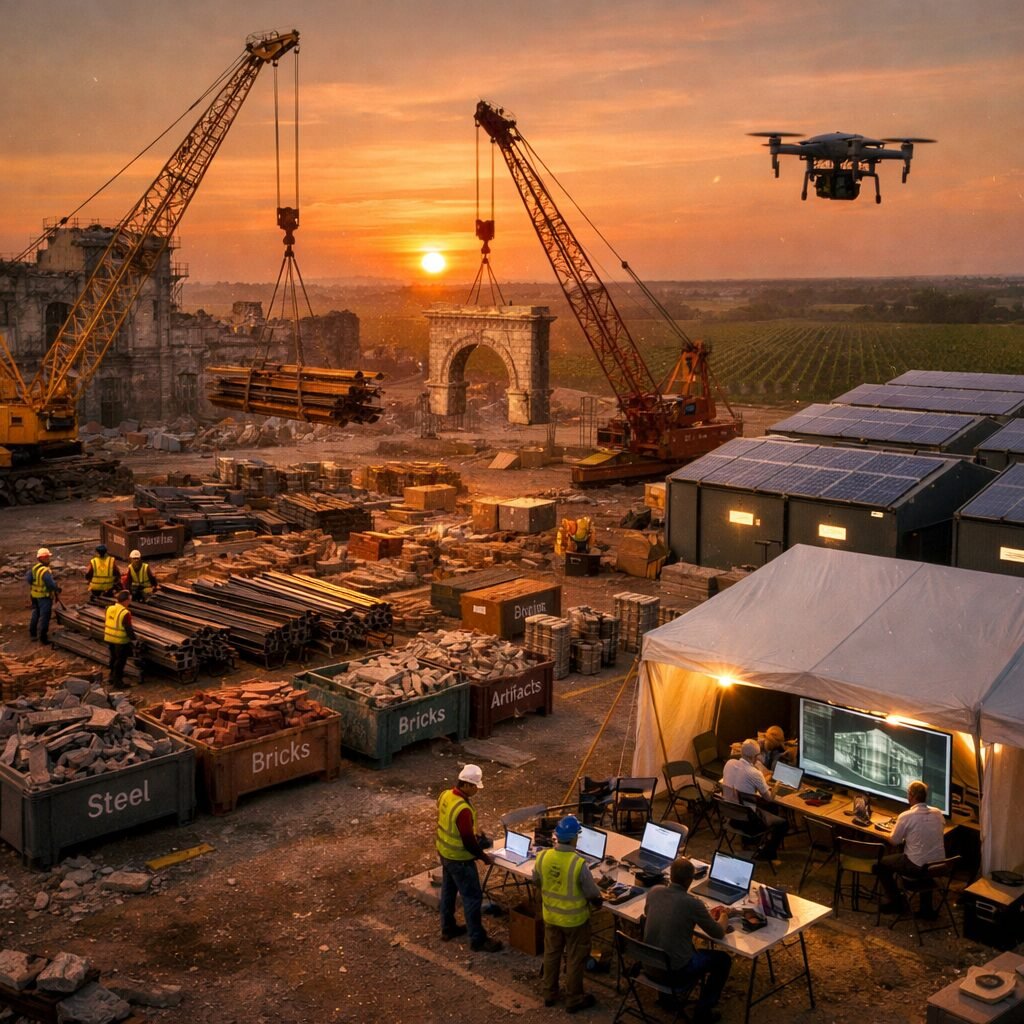
Recent conflicts have produced a pragmatic industry around recovery, reuse and rapid repurposing. Where warehouses, factories and entire neighbourhoods are damaged, a market emerges for salvage managers, deconstruction specialists and logistics firms that can extract value from ruin. These companies combine demolition, hazardous-materials handling and asset-tracing to turn wreckage into feedstock for rebuilding.
The techniques are migrating. Urban planners in European and North American cities now contract the same firms to dismantle decommissioned shopping centres and extract salvageable infrastructure — a quicker, cheaper and lower-carbon alternative to total demolition. Start-ups founded by ex-conflict salvage engineers are pitching their expertise as part of the circular economy, selling ‘urban material recovery’ as a service to municipalities aiming to meet sustainability targets.
Conflict Labs: From Battlefield Tech to Civilian Tools
The classic defence-to-civilian technology pipeline is evolving into a faster, more porous flow. Small ‘conflict labs’ — hybrid units inside private contractors, universities and NGOs — iterate rapidly on drones, sensor nets and modular communications for battlefield needs. Post-deployment, the same kits are re-engineered for agriculture, disaster response and industrial inspection.
A telling example: swarms of low-cost drones first fielded for reconnaissance are now optimised for pollination monitoring, coastal erosion surveys and precision spraying in viticulture. Companies market them as ‘battle-hardened’ devices — an uncomfortable phrase that nevertheless sells reliability. This recombination changes R&D timelines and funding models: venture capitalists increasingly co-invest with defence budgets, accelerating commercial rollout and blurring lines between military procurement and consumer tech.
The Insuranceisation of Reconstruction
War has prompted the creation of sophisticated risk-transfer instruments that reach far beyond troop movement or weapons damage. Reconstruction bonds, contingent sovereign-guarantee products and private catastrophe reinsurances designed for conflict zones have matured into tradable financial assets. These instruments allow governments, donors and private developers to finance rebuilding with risk share mechanisms that previously did not exist.
The consequence is twofold. First, reconstruction becomes a securitised commodity: investors buy into projects that promise returns contingent on milestones such as clearance of landmines or restoration of utilities. Second, it ingrains market incentives into decisions about who gets rebuilt first and how — raising ethical questions about prioritisation and equity. Academics and NGOs now track ‘reconstruction finance’ as an industry with its own lobbyists, rating agencies and advisory firms.
Cultural Markets, Provenance and New Conservation Economies
War destroys culture even as it creates markets for cultural goods and preservation services. The trafficking of antiquities is well known, but a subtler shift has been the rise of provenance verification, digital repatriation services and conservation-as-a-service. Museums and private collectors now commission forensic provenance research — using spectroscopy, provenance databases and blockchain ledgers — to legitimise acquisitions and protect assets in unstable regions.
Meanwhile, conservationists have turned emergency stabilisation techniques developed for bombed monuments into exportable services. Companies offer ‘rapid heritage triage’ to cities after disasters, combining 3D scanning, material consolidation and crowd-sourced memory archives. The result is a professionalised conservation economy that straddles philanthropy, diplomacy and commerce.
Legal Practice and Ethical Compliance: New Specialisms
Wars generate legal complexity: contracting in conflict zones, sanctions enforcement, mercenary regulation and humanitarian law disputes. Law firms and compliance consultancies have responded by forming niche practices that draft conflict-proof contracts, design sanctions-compliance systems and litigate reconstruction claims. These expertise hubs advise banks, insurers and corporations operating in exposed regions, often becoming gatekeepers of who may enter lucrative post-conflict markets.
This legal specialism has ripple effects: corporate governance standards now routinely include ‘conflict exposure’ assessments; auditors add provenance checks for supply chains; and international arbitration increasingly deals with war-era claims. The bureaucracy of conflict has thus produced an industry of advisers whose services normalise market activity in regions scarred by violence.
Humanitarian Logistics Meets Just-in-Time Commerce
Humanitarian organisations have long pioneered rapid-response logistics. Under sustained conflict pressure, they have industrialised those practices — investing in predictive supply-chain models, pre-positioned micro-hubs and modular warehousing that mirror commercial fulfilment centres. Private retailers and logistics providers have noticed: some have adopted similar micro-hub networks to deliver goods within unstable urban environments, while start-ups sell ‘conflict-hardened’ supply-chain solutions to firms operating globally.
The effect is a cross-pollination where humanitarian innovation improves commercial resilience and vice versa. Critics warn this can militarise aid structures and commodify relief, but proponents argue the improved speed and efficiency save lives and reduce waste.
Conclusion: A Troubled Engine of Change
Viewing war as an industry-transforming force does not neutralise its devastation. Yet acknowledging the ways conflict births new markets, practices and professional ecosystems is essential to grappling with modern political economy. These wartime industries — salvage and circular logistics, conflict labs, reconstruction finance, provenance economies, legal specialisms and hardened logistics — will keep shaping peacetime life, often in ways that evade public scrutiny.
Policymakers and citizens face a choice: accept these transformations passively, allowing market incentives to dictate rebuilding and innovation, or actively shape standards, transparency and ethical guardrails so that the downstream industries of war serve broader societal ends rather than reinforce inequality and secrecy.