
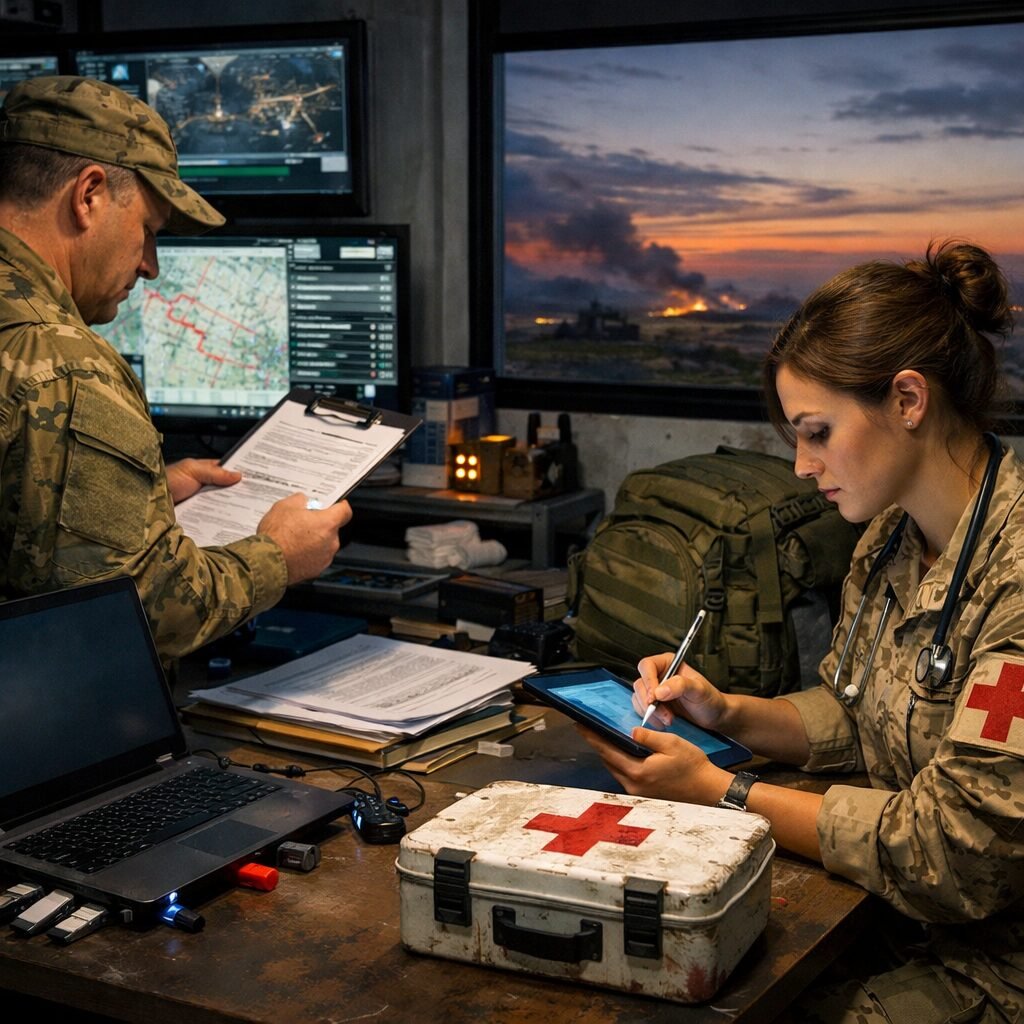
The Conversation No One Expects: War as an Institutional Problem
When defence analysts talk about war, they rarely begin with heroics. Instead they start with forms, grids and checkboxes. Senior logisticians and military planners describe conflicts as failures of institutions: misaligned incentives, broken procurement cycles, and brittle command chains. To them, the first casualty is often paperwork.
Retired generals and procurement officers speak of equipment that never arrives, doctrines written for an earlier decade, and the friction of inter-agency rivalry. These professionals insist that many wars are decided not by valour but by the speed at which administrations can adapt bureaucratically — the ability to authorise budgets, reroute supply, and transform peacetime contracts into wartime lifelines. Their verdict: modern war is as much an administrative contest as a battlefield one.
The Data Scientists: Algorithms, Errors and the Illusion of Precision
Data scientists embedded with militaries point to a modern paradox: we have more information than ever, yet clearer decisions are not guaranteed. Machine learning models predict attrition, target movement, and logistic bottlenecks, but experts caution against overfitting to rare events and underestimating human unpredictability.
Cyber specialists and intelligence analysts emphasise how biases in training data, adversary deception, and sensor blind spots produce confident — but wrong — outputs. A recurring refrain: technology amplifies existing decision-making cultures. If an organisation is risk-averse, more data will rarely fix timidity; if it is reckless, data can accelerate catastrophe. The professional takeaway is cautious: treat algorithms as advisers, not oracles.
Economists’ View: War as a Reallocation Problem, Not a Production Miracle
Macroeconomists and development experts reject the romantic notion that war spurs productive growth. Their models frame war as a violent reallocation of resources — human capital, factories, farmland — with long-term scarring. Reconstruction economists highlight path dependency: once supply chains break and skilled labour disperses, economies often shift into lower-productivity equilibria.
They also flag distributional dynamics. Wars redistribute risk and wealth: some firms and actors profit, many households suffer. Policy recommendations from these professionals are precise: protect institutions that preserve productivity (property registries, educational continuity, microfinance), and design aid to avoid creating rent-seeking winners from conflict.
Clinicians and Psychologists: The Invisible Logistics of Trauma
Frontline medics and psychiatrists describe a logistic fight against time and memory. Psychological professionals stress that casualty statistics miss long tails: chronic pain, traumatic brain injury, and intergenerational mental-health burdens. Treating war’s wounds is not only surgical; it is organisational — building referral networks, training non-specialist providers, and maintaining continuity of care amid displacement.
Therapists working in conflict zones emphasise that community-level interventions often have the greatest reach. Instead of singular heroic acts, they recommend scalable approaches: teacher-led psychosocial support in schools, peer-support groups among veterans, and mobile clinics that integrate mental and physical healthcare. The professional message is simple and unsettling: the real resource in long wars is a functioning health system.
Legal Minds and Ethicists: The Boundaries that Shape Violence
International lawyers and ethicists do more than litigate after the fact; they shape the conduct and perception of violence while it happens. Military lawyers (the ‘JAGs’) and human-rights experts note that legal frameworks can constrain escalation, channel strategies, and even make certain tactics less attractive by imposing reputational and criminal costs.
Practitioners emphasise the performative dimension of law: compliance or non-compliance influences foreign support, insurgent recruitment, and domestic morale. Ethicists add that rules of engagement and proportionality aren’t abstract ideals — they are decision tools that commanders use under pressure. Their counsel: law changes incentives, and incentives change behaviour.
Journalists and Historians: Narrative, Memory and the Market for Meaning
Reporters and historians point out that a war’s story is as strategic as its tactics. Journalists describe how access, framing and timing shape international sympathies and political pressure. Historians caution against teleological accounts that tidy mess into inevitability: they prefer process-tracing that highlights contingency, miscalculation and small moments that tipped contests.
Media professionals also examine the ‘market for meaning’ — the competition to define what a war is about. Winning narratives can mobilise coalitions, sustain home-front commitment, and justify prolonged engagement. The profession’s collective advice: guard the archive, interrogate sourcing, and remember that public memory is constructed, not discovered. For further reading on media and conflict, see analyses from institutions like Columbia Journalism Review and historical overviews at British Library.
The Common Thread: Professionals Ask Different Questions
Ask a combat surgeon, a cyber analyst, an economist or a legal adviser about war and you get different diagnostic questions — not just different answers. The professionals’ common contribution is a shift in focus: from the grand narrative of clash and conquest to the granular mechanics that make violence possible or unsustainable.
This perspective matters because it changes intervention priorities. Instead of searching for single transformative weapons or sweeping doctrines, the experts recommend shoring up institutions: supply chains, data governance, health systems, legal frameworks and storytelling mechanisms. In their view, the most consequential battles are often fought off-stage — in procurement meetings, hospital wards, courtrooms and newsrooms. Recognising that shifts the moral and policy conversation about what it means to prepare for, endure and recover from war.