
Preface: Why a ‘Beginner’s Guide’ to War?
Calling this a “beginner’s guide” is deliberately provocative. War is not a hobby; it is a human catastrophe with political, moral and material consequences. Yet many of us encounter war first as headlines, filtered social media clips, or the reductive metaphors of sport and gaming. This guide reframes “getting started” as an invitation to learn the languages, tools and responsibilities necessary to understand—not to glamourise—war.
Approaching war with a starter’s mindset means assembling a reliable toolkit: literacy in terms, awareness of sources, methods for analysing motives and consequences, and a discipline in ethical reflection. The aim is practical: to turn bewilderment into comprehension, and curiosity into a capacity for informed action—whether that be journalism, advocacy, humanitarian work, or simple, considered conversation.
Step 1: Learn the vocabulary — words that shape perception
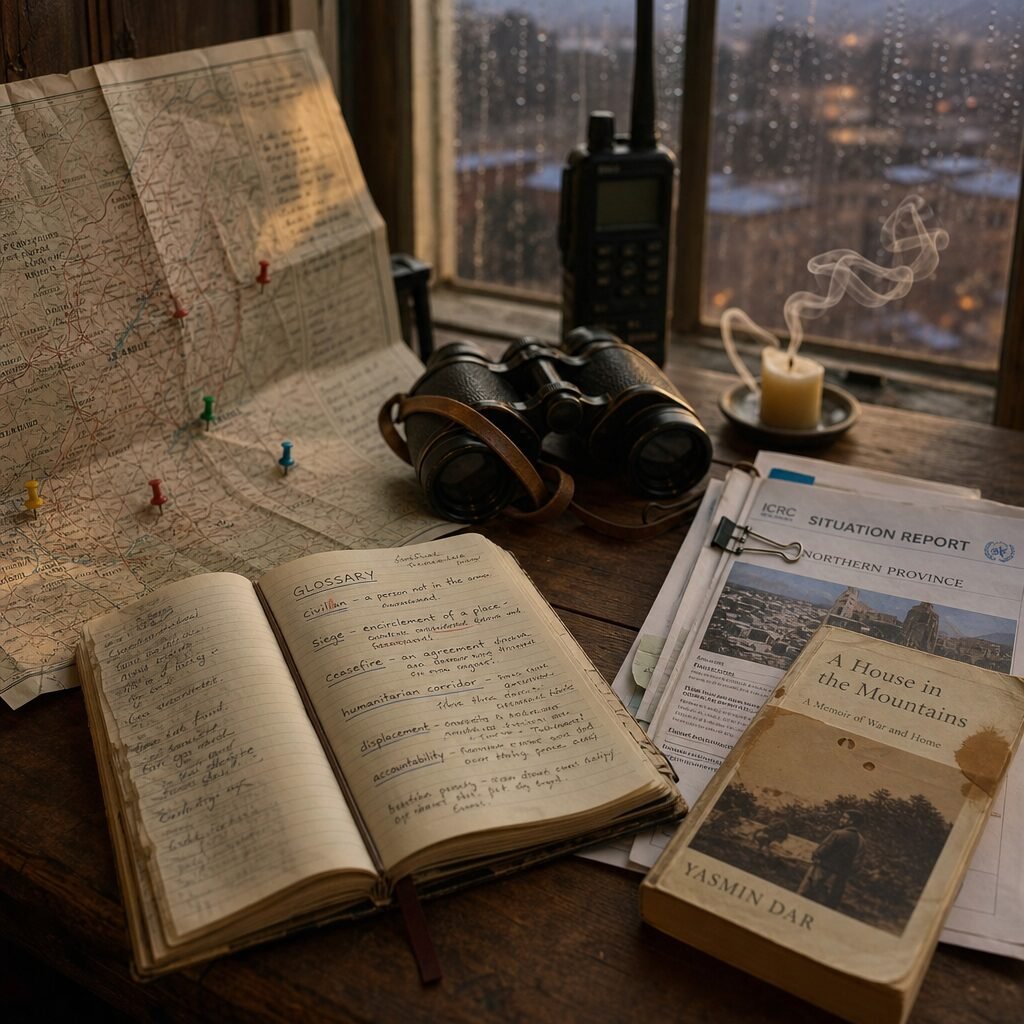
Language frames conflict. Casual phrases such as “collateral damage”, “theatre of operations” or “asymmetric” flatten lived experience into abstract nouns. A beginner should prioritise a short glossary: distinction between combatant and civilian, ceasefire, occupation, siege, humanitarian corridor, and internationally prohibited weapons. Understanding definitions is the first guardrail against manipulation.
But vocabulary alone is insufficient. Learn how words are deployed politically: what a government calls a “liberation” might be described by opponents as an “invasion”. Track how terminology shifts between official communiqués, independent reporting and local testimony. Comparing parallel vocabularies across sources reveals not just facts but narratives.
Step 2: Build your starter kit — maps, timelines and source hygiene
A practical kit helps you parse complexity. Start with a simple layered map: geography (cities, borders), infrastructure (roads, power, hospitals), and demographics (ethnic, linguistic, economic patterns). Place events on a concise timeline: sparks, escalations, diplomatic moves, and major civilian impacts. Visualising the sequence stops you mistaking fireworks for the whole show.
Equally crucial is source hygiene. Mix international media, independent local outlets, NGO situation reports, and primary documents when possible. Learn basic verification: reverse-image searches, geolocation using satellite imagery, and cross-checking timestamps. Beware single-source viral claims; cultivate a habit of triangulation. A dependable starter bibliography might include a respected international paper, a local-language outlet, an NGO brief and an academic overview for context.
Step 3: Simulate responsibly — games, wargames and ethical apprenticeship
Simulation is invaluable for grasping logistics, decision-making and unintended consequences—but simulation without reflection becomes dangerous. Wargames, tabletop exercises and carefully designed videogames can teach how supply lines collapse, how communication failures cascade, and why civilian harm often follows tactical choices. Seek simulations that foreground humanitarian constraints and non-combatant perspectives rather than pure victory conditions.
If you engage with hobby wargaming or professional exercises, add a debrief that asks: who pays the cost? Which assumptions were baked into the scenario? Consider following practitioners who focus on peacebuilding simulations, or participating in public workshops that pair tactical modelling with international law and medical response briefings. This is apprenticeship in humility rather than mastery.
Step 4: Learn the legal and moral boundaries — law, norms and responsibility
International humanitarian law (IHL) and human rights law set the boundaries for conduct in conflict. Beginners should familiarise themselves with the core principles: distinction, proportionality and military necessity. Understanding these ideas enables you to evaluate claims of legality and to recognise violations that demand accountability.
Legal literacy must sit alongside moral reflection. Ask who bears responsibility—combatant commanders, state actors, private contractors, or arms suppliers—and what remedies exist for victims. Explore mechanisms for accountability: international courts, truth commissions and sanctions. Remember that law provides tools; ethics supply the imperative to use them wisely.
Step 5: Humanitarian literacy — what to do (and not to do) to help
Many well-meaning newcomers want to help immediately. Start by learning how humanitarian systems function: who responds, what permissions are required, and where needs are greatest. Donating to established, transparent organisations and supporting vetted local groups often does more than ad-hoc aid drops.
Avoid actions that increase risk: untrained evacuations, unilateral delivery of supplies into contested areas, or publicising vulnerable locations on social media. Instead, channel energy into sustained support—funding, advocacy for safe corridors, pressure for ceasefires, or amplifying survivor testimonies. Humanitarian literacy is the bridge from empathy to effective, ethical action.
Step 6: Memory, story and the long haul — learning to stay with the aftermath
War does not end with a treaty. Reconstruction, memory politics and trauma can persist for generations. A beginner should cultivate patience: follow the aftermath as closely as the outbreak. Read survivor memoirs, local histories and restorative justice reports to understand how societies reckon with violence.
Engage with cultural responses—film, literature, music and memorials—because they reveal how communities process loss and reconstruct identity. Advocates and analysts who commit to the long haul help ensure that lessons are learned, reparations pursued, and structures changed to reduce future harms.