
Frontlines of Emissions: The Carbon Calculus of War
War is usually measured in casualties and territory. Yet beneath those metrics lies a different ledger: carbon, toxic dust and ruined sinks. Modern conflict releases vast quantities of greenhouse gases through direct combustion of fuel, destruction of infrastructure and the sudden loss of carbon-storing landscapes. Military vehicles, jets and naval fleets are among the heaviest institutional emitters per unit of activity, and continuous operations within a theatre of war can eclipse a nation’s peacetime emissions for months.
Beyond immediate combustion, the demolition of power plants, refineries and industry turns infrastructure into rolling pollutants. Fires in cities and forests pump particulate matter and CO2 into the atmosphere; ruptured pipelines and chemical releases create long-lived contamination that undermines the capacity of soils and wetlands to sequester carbon. The immediate carbon tally is thus intertwined with decades of lost sinks—peatlands drained by battles, forests clear-felled, and coastal wetlands buried beneath rubble. Any credible assessment of a war’s climate impact must add the silent, slow violence against nature to the visible ruin.
Battlefields as Accidental Ecologies
Paradoxically, some battlefields become refuges. Areas cut off from intensive agriculture and development can regenerate into semi-wild landscapes—witness the unexpected biodiversity that has emerged in demilitarised zones and abandoned peripheries. These accidental sanctuaries reveal how quickly ecosystems can rebound when human pressures are removed, offering lessons for conservation design.
But this regeneration is uneven and often precarious. Soil contamination from heavy metals, unexploded ordnance and persistent organic pollutants can render recovered habitats toxic to fauna and humans alike. In many cases, what appears as rewilding masks ecological impoverishment: fewer species, altered food webs and substrates that store less carbon. Understanding the difference between genuine ecological recovery and a dangerous, contaminated veneer is essential for post-conflict restoration planning.
Hidden Toxins: The Long Legacy of Munitions and Industry
Munitions and military logistics leave a chemical fingerprint that outlives treaties. Lead, mercury, perchlorates and PFAS (per- and polyfluoroalkyl substances) used in firefighting foams and coatings persist in soil and groundwater, moving through food chains and impairing ecosystem services. Cleanup is rarely immediate; unexploded ordnance (UXO) delays land reclamation for decades, and demining itself can exacerbate erosion, resuspending contaminants.
The true environmental cost is often borne by local communities—agricultural livelihoods collapse, water sources become unreliable, and healthcare systems strain under new burdens of chronic disease. Remediation technologies exist but are expensive and technologically demanding. Without sustained international funding and expertise, contaminated landscapes risk becoming permanently marginalised, turning once-productive regions into long-term humanitarian and ecological crises.
Salvage Economies and Circularity at the Front
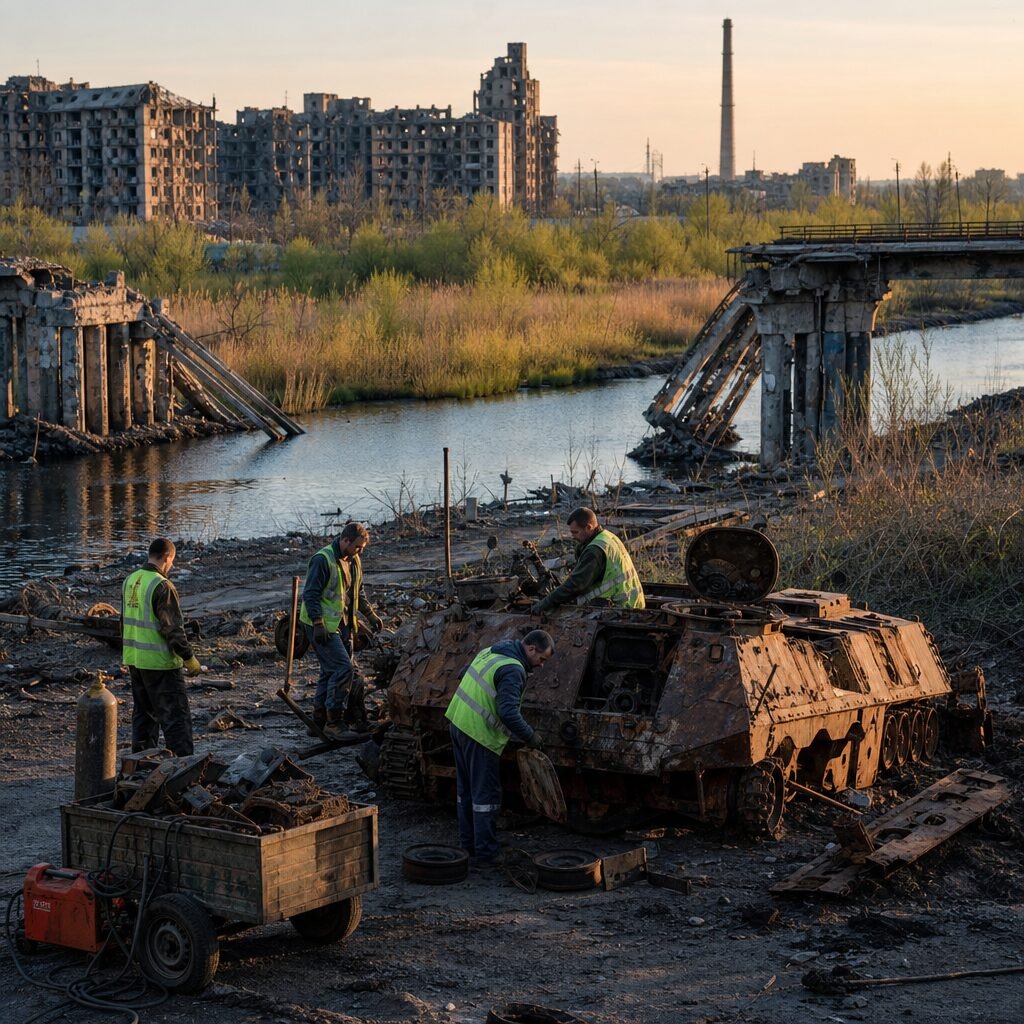
Conflict spawns informal circular economies. Salvagers recover metal from wreckage, repurpose plastic and scavenge electrical components—an ad hoc circularity driven by necessity rather than design. These local systems reduce waste and provide livelihoods, but they can also perpetuate hazardous exposures and undermine formal recycling markets.
There is opportunity in formalising these practices. Training salvagers in safe dismantling, establishing secure supply chains for recovered materials and embedding environmental standards in post-conflict procurement could convert survival-driven recycling into resilient, low-carbon local industry. International agencies and NGOs can incubate micro-enterprises that turn battlefield detritus into usable building materials, supporting reconstruction while limiting virgin material extraction.
Reconstructing for Resilience: Green Recovery and Policy Imperatives
Reconstruction is a decisive moment: countries can rebuild old vulnerabilities or pivot to sustainable, resilient systems. Green recovery frameworks—focusing on decentralised renewable energy, nature-based flood protection and circular waste systems—can reduce long-term emissions while delivering jobs and infrastructure that resist future shocks. Integrating environmental assessments into peace agreements and reconstruction funding ensures that the cost of repair includes remediation of ecosystems and restoration of ecosystem services.
Success requires three linked shifts: treat environmental damage as reparable liability in post-conflict compensation schemes; condition international aid on sustainable reconstruction standards; and invest in local capacity for remediation, monitoring and green job creation. Innovative finance—green bonds tied to reconstruction, insurance products for restored wetlands, and carbon credits for verified rewilding—can mobilise capital but must be designed to avoid greenwashing. When done well, rebuilding offers an ethical and pragmatic route to transform the scars of conflict into a more resilient, low-carbon future.
The Strategic Value of Ecosystem Services
Ecosystems are not abstract amenities; they are strategic assets. Floodplains, forests and wetlands buffer communities from disasters, purify water and underpin food security. Targeting or collateral damage to these systems undermines long-term stability. Recognising ecosystem services as critical infrastructure reframes protection as a security imperative.
This perspective should prompt new rules of engagement and post-conflict accountability: protecting key carbon sinks and water catchments during operations, mandating environmental impact assessments for military plans, and including ecological restoration in reparations. Such measures align national security with planetary security—reducing the risk that environmental degradation becomes a multiplier of conflict.
From Reckoning to Responsibility: Practical Steps Forward
An ecological approach to war begins long before treaties are signed. Militaries can decarbonise logistics, adopt less-polluting materials and phase out persistent chemicals. Humanitarian and reconstruction funding can prioritise remediation and nature-based solutions. International law should evolve to recognise environmental destruction as an element of reparable harm, backed by mechanisms for monitoring and financing restoration.
Civil society and local communities must be central: their knowledge of landscapes and livelihoods is indispensable for effective recovery. The real test is not only how quickly rubble is cleared, but how intentionally the next landscape is designed—one that heals soils, stores carbon and supports sustainable livelihoods. If that happens, the terrible returns of war might at least yield a hard-won chance to build back greener.