
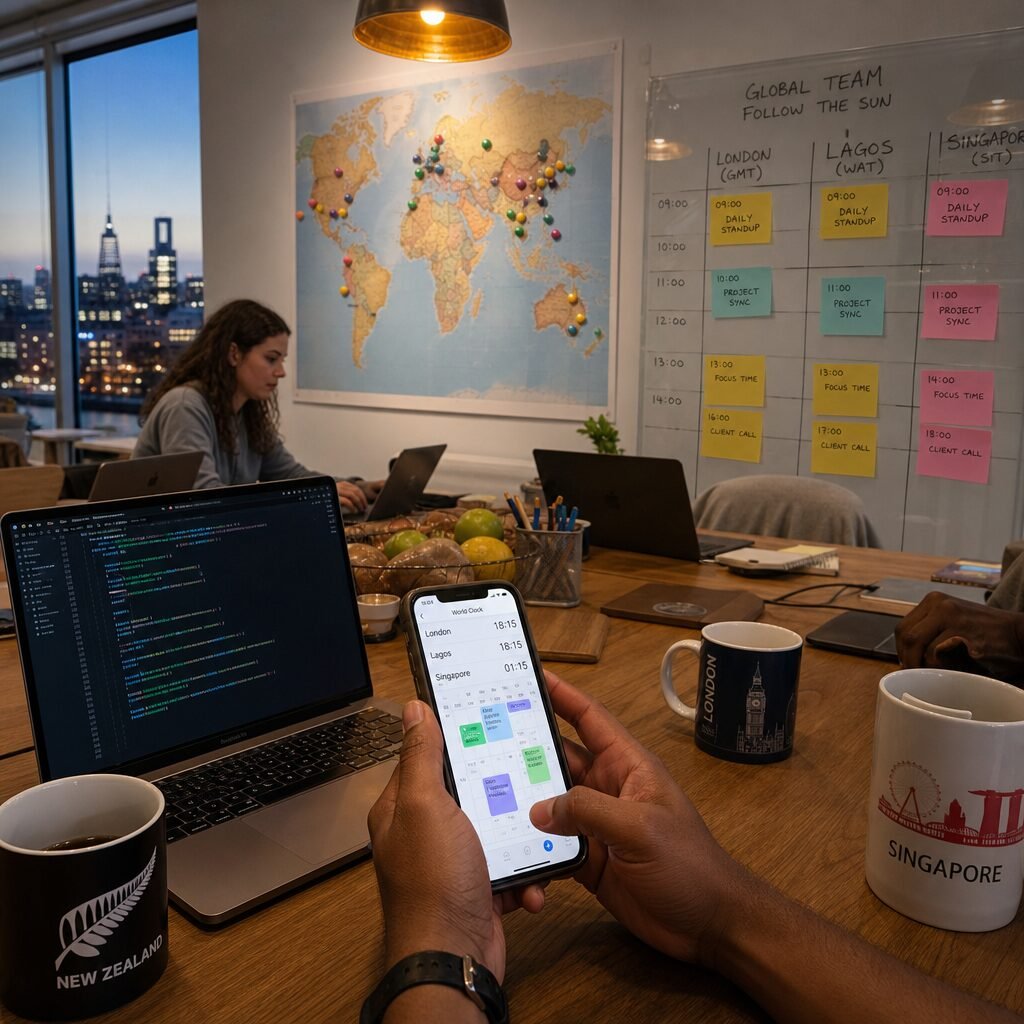
The Timezone as Coworker: Designing Routines Around Global Clocks
Modern workflows increasingly treat timezones as active collaborators rather than obstacles. Instead of forcing a 9–5 cadence on a dispersed team, savvy professionals build “timezone chains”: staggered handoffs where one member finishes a deep-focus task and another resumes with fresh context. This transforms waiting time into productive overlap — the evening worker codes, the morning worker reviews and deploys.
Practically, this requires ritualised communication: concise end-of-day notes, shared checklists, and asynchronous demos recorded at the last meaningful checkpoint. Tools such as shared calendars with automatic timezone conversion, and lightweight status pages, reduce cognitive load. See examples at timeanddate.com for visualising overlaps. The result is a rhythm that respects circadian health while extending the working day without burnout.
Micro-Internationalism: Making Global Perspectives Part of Your Daily Workflow
International isn’t only about travel or multinational corporations; it can be a micro-habit woven into daily work. Micro-internationalism means deliberately inviting small, regular international inputs: a 10-minute read of a foreign-language newsletter (via translation tools), a weekly call with a counterpart in another market, or rotating case studies from different regulatory environments.
These tiny practices broaden pattern recognition and reduce cultural myopia. Over months they compound into a decision-making advantage: when a product tweak fails in one region, teams with micro-international habits can cross-reference distant cases and adapt faster, often spotting solutions that local teams would miss.
The Polyglot Calendar: Scheduling for Cultural Rhythms and Rituals
A truly international workflow recognises that calendars are cultural artefacts. Public holidays, religious observances and local workweek norms shape attention and availability. The polyglot calendar is an operational tool that overlays these rhythms onto project timelines.
Teams should map critical milestones against regional calendars, allowing buffer windows and alternative reviewers. Beyond logistics, this approach fosters respect: acknowledging Ramadan‑related hours or Golden Week in Japan reduces friction and signals psychological safety. Practically, shared calendar layers and a ‘holiday impact’ column in project plans prevent last-minute scramble and redistribute risk more equitably.
Currency of Ideas: Translating Local Innovations into Global Practice
International workflows create a marketplace where ideas, not only goods, are exchanged. The key is translation — not just language, but contextual adaptation. A checkout innovation in India, for example, may need UX simplification for markets with different device habits; a Scandinavian workplace experiment might inspire flexible parental policies elsewhere if reframed for different legal frameworks.
Organisations that excel build ‘translation circuits’: multidisciplinary teams that test whether a local solution can be adapted and scale. These circuits document constraints, assumptions and necessary pivots, creating a living library of transferrable practices. Over time, the organisation’s operational vocabulary grows richer and more resilient.
Borderless Tools, Rooted Ethics: Choosing Tech with Local Consequences in Mind
Many tools position themselves as ‘borderless’, but their deployment has local consequences — data sovereignty, access inequality, and surveillance risk vary dramatically. Integrating international thinking into tool selection means evaluating not only features but the geopolitical implications of where data is stored and how algorithms behave across cultures.
Teams should adopt an ethical checklist: data residency requirements, consent expectations, and algorithmic fairness in diverse populations. Additionally, favour modular, locally deployable options where possible, and maintain a ‘fallback’ plan for regions with restrictive infrastructure. This mixes pragmatism with responsibility, ensuring efficiency doesn’t trample local rights.
Everyday Rituals for a Global Mindset
Finally, cultivating an international workflow is as much about habits as systems. Simple rituals anchor global thinking: start meetings with a one-sentence market update, rotate meeting times to share inconvenience equitably, and maintain a communal “learning pot” where team members drop links to research from other regions.
These rituals create a culture where international awareness is habitual rather than performative. Over time they turn global complexity from a cost into a source of creativity and resilience.