
The Myth of the Eternal Warrior
Walk through any museum of antiquity and you will find the same story told in bronze and stone: humans have always been at war. Sumerian reliefs depict spear-carrying soldiers. Egyptian tombs celebrate pharaohs smiting their enemies. Greek vases glory in the fall of Troy. The message seems clear—war is as old as humanity itself, an inseparable feature of our species’ existence.
But what if this narrative is not merely incomplete, but fundamentally wrong?
Recent archaeological and anthropological research suggests something startling: organised warfare is a relatively recent invention in the human story. For the vast majority of our existence as a species, humans lived without war as we understand it. The concept of group-on-group lethal conflict, with its armies, strategies, and political objectives, emerged not from some primal bloodlust hardwired into our DNA, but from specific historical circumstances that transformed human society roughly 10,000 to 12,000 years ago.
This revelation forces us to confront an uncomfortable question: if war is not an eternal feature of the human condition, but rather an invention—like agriculture, writing, or the wheel—then perhaps it can also be uninvented.
The Word That Conquered All
The very language we use to describe armed conflict reveals its surprisingly recent origins. The English word ‘war’ derives from the Old High German ‘werra’, meaning confusion, discord, or strife—a term that originally described interpersonal quarrels rather than organised military campaigns. This etymological root is telling: before war became an institution, it was merely a word for the chaos of human disagreement.
Linguistic analysis across ancient languages shows that specific terms for ‘war’ as a distinct, institutionalised activity emerged remarkably late. Ancient Sumerian, one of the earliest written languages, initially lacked a dedicated word for warfare. The concept was instead expressed through phrases meaning ‘to go against’ or ‘to make hostile’, suggesting that early Mesopotamian societies viewed armed conflict as a specific action rather than a permanent state of affairs.
Even more fascinating is the Roman concept of ‘bellum’, from which we derive ‘bellicose’ and ‘antebellum’. The Romans didn’t simply have wars—they formally declared them through elaborate religious rituals performed by the fetial priests. War was so far from being a natural state that it required divine sanction and ceremonial proceedings to make it legitimate. The Romans understood something we have forgotten: war is an artificial construct, a deliberate breaking of the normal peace that requires justification and ritual.
The Peaceful Prehistoric Record
For decades, archaeologists searching for evidence of prehistoric warfare found precious little. The fossil record of early humans—Homo sapiens and our evolutionary cousins—shows remarkably few signs of interpersonal violence, let alone organised group conflict. A 2016 study published in the journal Nature examined remains from over 20 prehistoric sites across Europe and the Near East dating from 13,000 to 5,000 years ago. The findings were striking: evidence of violent death was exceedingly rare, accounting for less than 2% of all deaths in most populations.
Anthropologist Douglas Fry of the University of Alabama has spent decades studying conflict in hunter-gatherer societies. His work challenges the popular perception that our ancestors lived in a state of constant tribal warfare. ‘When you actually look at the ethnographic and archaeological record,’ Fry explains, ‘what you find is that most nomadic forager groups have multiple mechanisms for avoiding and resolving conflicts. Warfare, in the sense of organised group combat, is the exception rather than the rule.’
The evidence suggests that early human societies were remarkably adept at conflict resolution. Kinship networks, marriage alliances, gift exchanges, and ritualised forms of dispute resolution all served to keep the peace. When violence did occur, it was typically between individuals and was dealt with through customary justice systems—not through the kind of escalating retaliatory raids that characterise true warfare.
When War Was Born
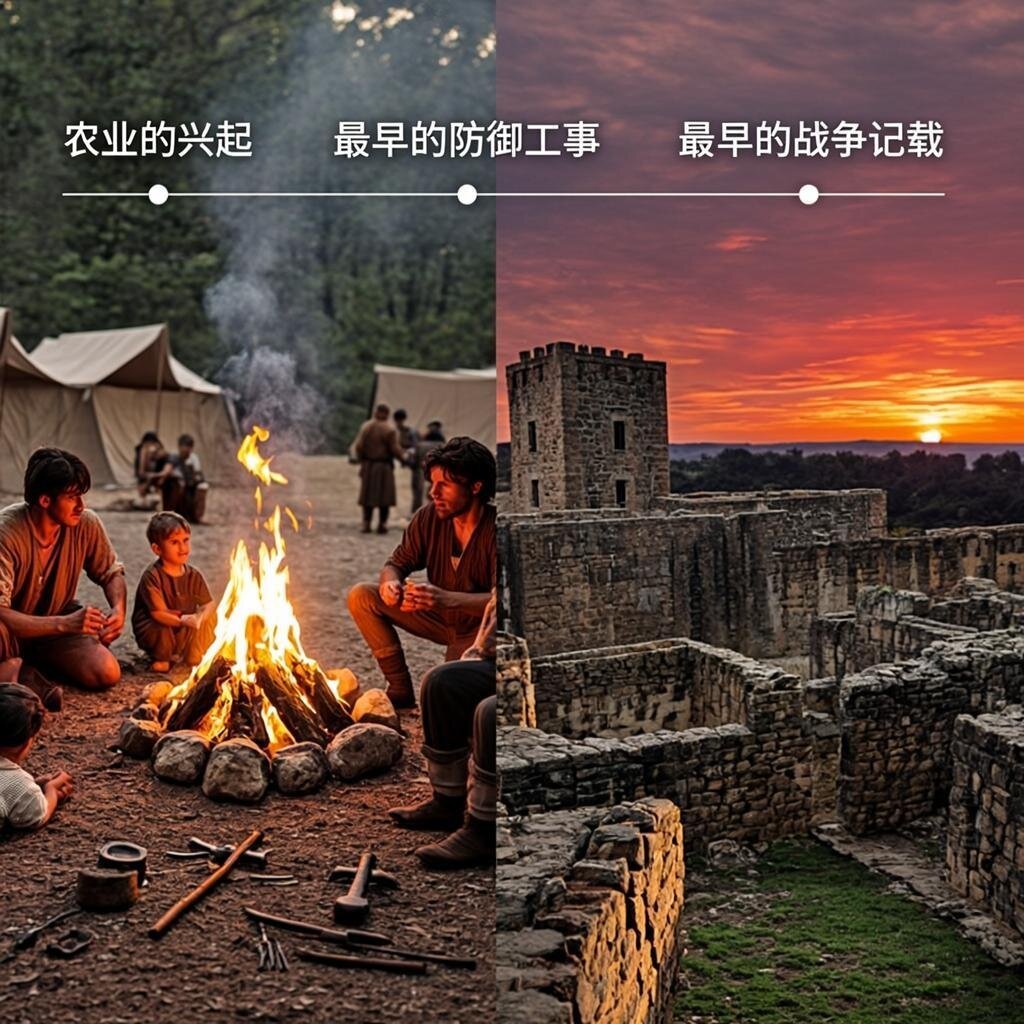
So when did war actually begin? The archaeological record points to a specific period: the transition from hunter-gatherer societies to agricultural ones, roughly 10,000 years ago. This Neolithic Revolution brought about fundamental changes in human social organisation that made warfare both possible and, in some contexts, advantageous.
The first clear evidence of organised warfare comes from the Jebel Sahaba cemetery in Sudan, dating to approximately 13,000 years ago. Here, archaeologists discovered 61 individuals buried with evidence of violent deaths—stone projectiles embedded in bones, defensive wounds on arms. But Jebel Sahaba appears to be an exception that proves the rule: it represents one of the earliest known instances of group conflict, occurring precisely during a period of climate stress and resource competition.
As agriculture spread, it brought with it the conditions that made warfare systematic. Settled communities accumulated wealth in the form of stored grain, livestock, and material goods—resources worth raiding. Land became valuable in ways it never had been for nomadic peoples. Populations grew, straining resources. Social hierarchies emerged, creating leaders with the power to mobilise groups for collective violence.
The first fortifications appeared around 8,000 years ago in the Near East. The first specialised weapons—swords, maces, and other instruments designed specifically for killing humans rather than hunting animals—emerged roughly 5,000 years ago. The first written records of organised military campaigns date to around 4,500 years ago, with the Stele of the Vultures commemorating the victory of the Sumerian city-state of Lagash over its rival Umma.
From Ritual to Ruin
Perhaps the most surprising aspect of war’s origins is how ritualised and constrained early conflicts were. Far from the total war of modern imagination, early warfare in many societies followed strict rules and served ceremonial functions as much as practical ones.
Among many indigenous peoples of Papua New Guinea, warfare was conducted according to elaborate conventions. Battles were scheduled in advance, fought on designated grounds, and ceased after a specific number of casualties. The objective was not annihilation but the restoration of balance and the demonstration of strength. Similar patterns have been documented among the Yanomami of the Amazon, the Maori of New Zealand, and various Native American peoples.
In ancient Greece, the hoplite phalanx warfare of the classical period was governed by implicit rules. Battles were typically fought in summer, on flat plains, during daylight hours. The objective was to break the enemy’s formation, not to pursue and slaughter the defeated. These conventions, known as ‘agonistic warfare’, reflected a view of combat as a form of regulated competition rather than a struggle for existential survival.
The transformation of war from ritualised contest to total conflict occurred gradually, driven by technological innovations, political centralisation, and ideological shifts. The invention of the chariot, the development of iron weapons, the rise of professional standing armies—all contributed to making warfare more destructive and less constrained by custom. By the time of the Assyrian Empire in the 8th century BCE, warfare had evolved into a tool of imperial terror, with kings boasting of flaying captured enemies and depopulating entire regions.
War’s Unexpected Legacy
If war is an invention rather than an instinct, its consequences have shaped human civilisation in ways we rarely acknowledge. The pressure of organised conflict drove technological innovation, from metallurgy to engineering. The need to coordinate large numbers of men in battle accelerated the development of writing, mathematics, and bureaucracy. The walls built to defend cities became the boundaries that defined early states.
Anthropologist Margaret Mead famously argued that warfare is an invention, not a biological necessity. In her 1940 essay of the same name, she wrote: ‘If we say that war is a biological necessity, we have given up all hope of controlling it. If we say it is an invention, we have opened the door to the possibility of its replacement by a better invention.’
This perspective offers a fragile but genuine hope. The same human creativity that invented war can create alternatives. International institutions, diplomatic frameworks, and global trade networks represent attempts to build systems that make organised conflict less necessary and less likely. They are imperfect and often fragile, but so were the first attempts at organised warfare.
Understanding war as an invention—a specific historical response to particular circumstances rather than an eternal feature of human nature—changes how we think about peace. Peace is not merely the absence of war, a temporary pause in an endless cycle of violence. It is, perhaps, the natural state from which war temporarily diverted us. The archaeological record suggests that for 90% of human history, we managed without it.
The question is whether we can learn to do so again.