
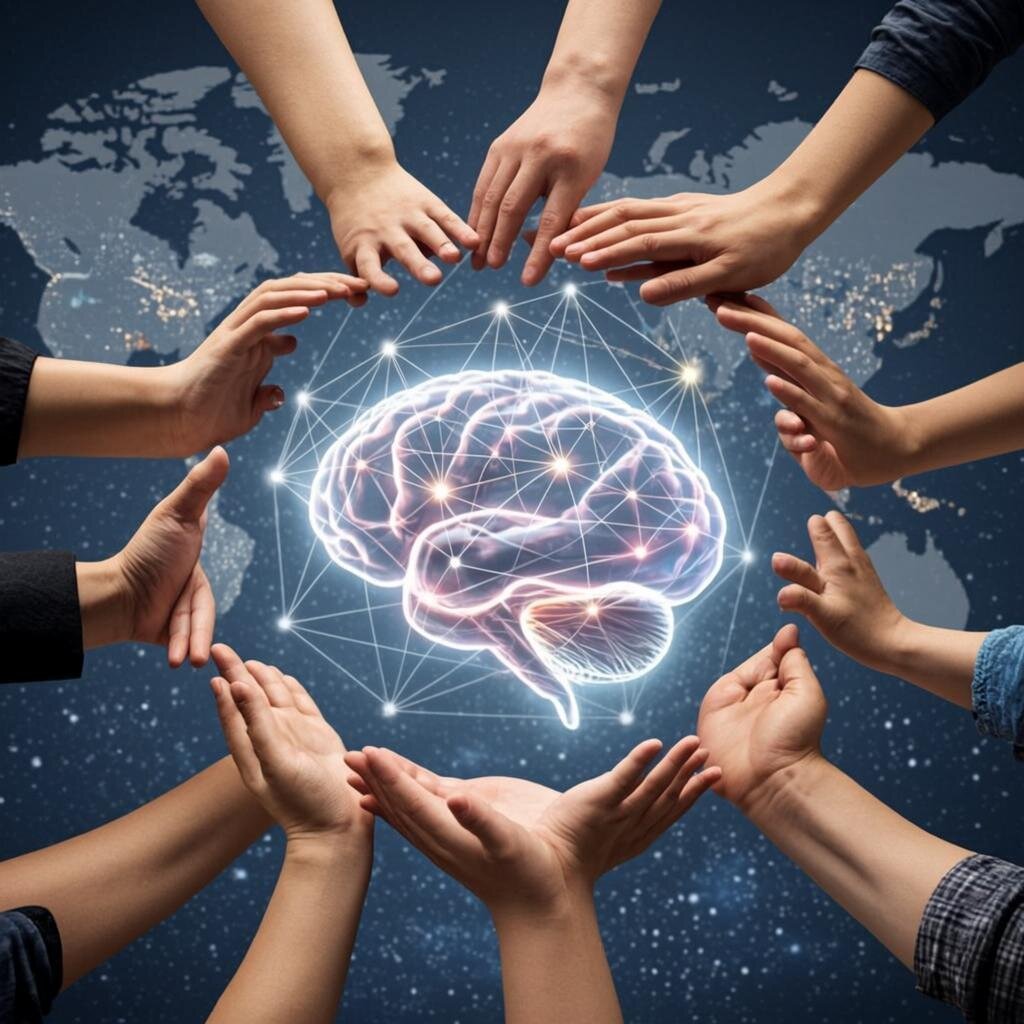
The Surprising Mathematics of Cross-Border Minds
In 2019, a team of researchers at Harvard Business School published a study that sent quiet ripples through the corporate world. After analysing 1.5 million scientific papers published over a decade, they discovered something remarkable: papers authored by international teams were cited 35% more often than those written by domestic groups, even when controlling for institutional prestige and field of study. The finding wasn’t merely academic trivia—it represented a quantifiable measure of how international collaboration produces objectively better ideas.
The Harvard study is just one data point in a growing body of evidence suggesting that ‘international’ isn’t just a political concept or a business strategy—it’s a cognitive multiplier. When minds trained in different cultural, educational, and linguistic traditions collide, something happens at the level of neural processing that simply cannot be replicated within homogeneous groups. The science behind why international works reveals a truth that feels almost counterintuitive in our age of rising nationalism: human intelligence itself becomes more powerful when it crosses borders.
This isn’t sentimental globalism. It’s measurable, replicable, and grounded in disciplines ranging from cognitive neuroscience to evolutionary biology to network theory. Understanding the mechanisms behind this ‘diversity dividend’ may be one of the most important scientific questions of our interconnected century.
Cognitive Diversity: Your Brain on Different Perspectives
The key to understanding why international collaboration works lies in a concept cognitive scientists call ‘cognitive diversity’—the variety of mental models, problem-solving approaches, and heuristic frameworks that different cultures cultivate. Research from the University of Michigan’s Cultural Cognition Lab has demonstrated that people from different cultural backgrounds genuinely perceive and process information differently, not just in terms of values but in fundamental visual and analytical processing.
In one striking experiment, researchers showed participants from East Asian and Western backgrounds identical images of complex scenes. Eye-tracking technology revealed that Western participants focused quickly on central objects, whilst East Asian participants spent more time scanning contextual background information. Neither approach is superior—but together, they capture more complete information than either could alone. When these different perceptual styles collaborate on problems requiring comprehensive analysis, the combined attention covers more intellectual terrain.
This principle extends far beyond visual processing. Studies by organisational psychologist Scott Page at the University of Michigan have mathematically demonstrated that groups with diverse cognitive toolkits consistently outperform homogeneous groups of higher-performing individuals on complex problem-solving tasks. His ‘Diversity Prediction Theorem’ shows that the collective error of a diverse group is always less than the average individual error—a mathematical proof that international diversity doesn’t just feel beneficial, it’s computationally optimal.
The Neuroplasticity of Cross-Cultural Exposure
Neuroscience offers an even more intimate view of why international experience changes how brains function. Studies using functional magnetic resonance imaging (fMRI) have shown that people who have lived in multiple countries develop measurably different neural connectivity patterns, particularly in regions associated with creative thinking and cognitive flexibility.
A 2018 study published in the Journal of Cross-Cultural Psychology found that individuals with extensive international experience showed increased grey matter density in the anterior cingulate cortex—a region crucial for managing conflicting information and switching between different mental frameworks. The researchers compared this to physical exercise: just as running strengthens cardiovascular systems, navigating cultural ambiguity appears to strengthen neural networks responsible for adaptive thinking.
Even more fascinating, research from the University of Florida has demonstrated that these neurological benefits can be transmitted through close relationships. People with deep connections to individuals from other cultures show similar cognitive enhancements, suggesting that international collaboration doesn’t just combine different brains—it actively reshapes them. The implications are profound: international cooperation may literally evolve human cognitive capacity, creating brains better equipped for the complex challenges of our interconnected world.
The Innovation Geography: Mapping Where Breakthroughs Happen
When economists map global patent citations and scientific breakthroughs, a clear geographic pattern emerges: innovation clusters disproportionately in international hubs. Silicon Valley, Singapore, London, and Tel Aviv don’t dominate by accident—they’re places where diverse intellectual traditions physically intersect. Research from the Brookings Institution found that American metropolitan areas with higher rates of international migration produced 40% more patents per capita than less diverse regions.
This isn’t simply about attracting talent from elsewhere. Studies of ‘knowledge spillovers’—the phenomenon where ideas leak between disciplines and cultures—show that international connections act as bridges between otherwise isolated knowledge networks. A mathematician in Tehran might approach a problem differently than one in Toronto, and when their approaches combine, novel solutions emerge that neither would have discovered independently.
The data becomes even more compelling when examining specific fields. In pharmaceutical research, international clinical trials produce more replicable results than single-country studies. In artificial intelligence development, teams spanning multiple continents create algorithms with less cultural bias and broader applicability. The pattern repeats across disciplines: international collaboration doesn’t just add perspectives—it creates emergent possibilities that couldn’t exist within any single national context.
Evolutionary Origins: Why We’re Wired to Connect Across Tribes
The scientific case for international collaboration gains additional weight when viewed through an evolutionary lens. Anthropologists have long puzzled over why humans developed the capacity for cooperation beyond kinship groups—a trait that seems to contradict the competitive logic of natural selection. Recent research suggests that intergroup cooperation may have been essential to our species’ survival, hardwiring international collaboration into our very biology.
Studies of contemporary hunter-gatherer societies reveal extensive trade networks and marriage exchanges between distant groups, creating biological and cultural connections that span hundreds of miles. These networks weren’t merely economic—they served as insurance systems, allowing groups to access resources and innovations from distant communities during local crises. Evolutionary biologists now believe that humans who could form these cross-group bonds had significant survival advantages, passing down genetic predispositions for international cooperation.
This evolutionary heritage may explain why international collaboration feels genuinely rewarding to many people. Neuroimaging studies show that successful cross-cultural cooperation activates the brain’s reward centres more strongly than within-group cooperation—a neurological echo of the survival advantage our ancestors gained from building bridges beyond their immediate communities. International collaboration isn’t just strategically beneficial; it may be what our brains evolved to do.
The Economic Evidence: Following the Data
The economic data on international cooperation tells a consistent story across scales. At the macroeconomic level, countries with higher rates of international trade and collaboration show faster GDP growth, greater innovation rates, and more resilient economies during crises. The World Bank estimates that countries that increased their international collaboration indices by 10% saw average GDP growth improvements of 1.2 percentage points over the following decade.
At the organisational level, McKinsey’s landmark ‘Diversity Matters’ research across 1,000 companies in 12 countries found that companies with international leadership teams were 33% more likely to outperform their peers on profitability. The correlation was strongest in industries requiring innovation and complex problem-solving—exactly the domains where cognitive diversity should provide the greatest advantage.
Even at the individual level, the data is compelling. Longitudinal studies tracking professionals over decades show that those with international experience earn 15-20% more over their careers than peers with similar qualifications who remained domestic. This ‘international premium’ persists even after controlling for education, family background, and initial career trajectory, suggesting that something about international collaboration itself enhances human capital in measurable ways.
The Future of International Intelligence
As artificial intelligence and digital communication make international collaboration easier than ever, the scientific case for embracing cross-border cooperation becomes increasingly urgent. The challenges facing humanity—from climate change to pandemic response to economic inequality—are inherently international problems requiring international solutions. The science suggests we’re not just politically or economically interdependent; we’re cognitively interdependent, with brains that function best when connected to diverse global networks.
The research also offers a hopeful counter-narrative to rising nationalism and isolation. If international collaboration genuinely makes us smarter, more creative, and more capable of solving complex problems, then the political impulse toward closing borders represents not just economic folly but cognitive self-harm. The science of why international works reveals that our greatest competitive advantage as a species has always been our ability to connect across differences—to transform the friction of diverse perspectives into the spark of innovation.
Understanding these mechanisms doesn’t just help us appreciate international collaboration—it provides a roadmap for designing better institutions, more effective teams, and stronger communities. In a world where the problems are global and the solutions require unprecedented cooperation, knowing how to harness the cognitive power of international diversity may be the most important skill we can develop. The data is clear: international collaboration doesn’t just feel right. It works, in ways we’re only beginning to understand.