
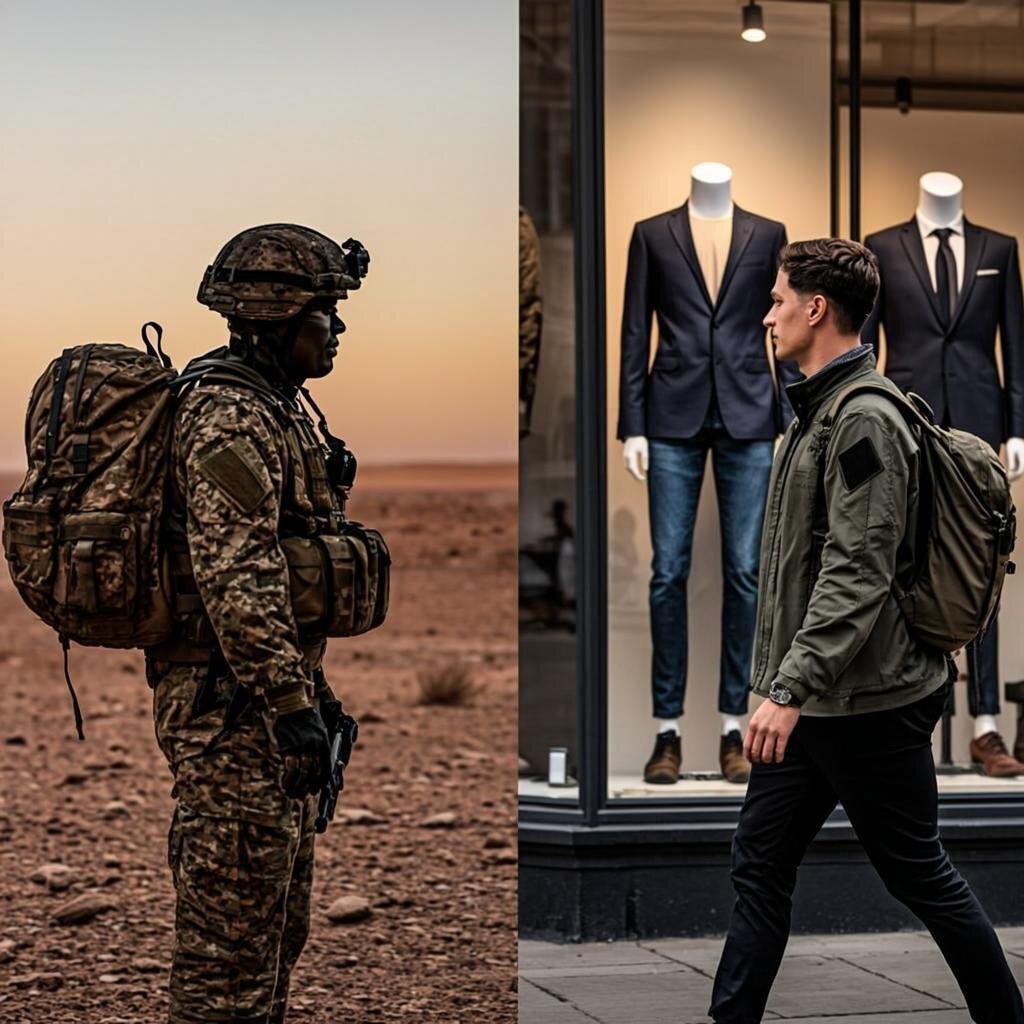
The Militarisation You Cannot See
Walk down any high street in Britain today and you are, whether you know it or not, walking through a gallery of war’s cultural remnants. The cargo trousers in the shop window. The drone hovering above the park. The phrase ‘bootstrap mentality’ on the self-help book cover. We have been told, repeatedly, that war is something that happens elsewhere — in distant territories, on rolling news broadcasts, in history books. But the truth is far more intimate. War has been quietly conscripting our wardrobes, our workouts, our weekend hobbies and even our vocabulary.
This is not about remembrance or politics. It is about something stranger: the way conflict bleeds into the mundane, transforming the ordinary into something shaped by the battlefield. From the rise of ‘tactical’ lifestyle brands to the explosion of military-inspired fitness regimes, from the aesthetics of survivalism in interior design to the language of ‘frontline workers’ and ‘war rooms’ in corporate Britain, war’s fingerprints are everywhere — if you know where to look.
What follows is an exploration of how modern culture has absorbed, repackaged and sold back to us the textures of war, often without us realising it.
Fashion’s Long Love Affair with the Battlefield
Military fashion is not new — the trench coat, after all, was literally born in the trenches of the First World War. But what is striking is how thoroughly military aesthetics have colonised contemporary fashion in ways that go far beyond the seasonal ‘camo trend’.
Consider the rise of ‘techwear’ — a fashion movement obsessed with utility, weatherproofing and modular design. Its silhouettes are pure military: cropped jackets, voluminous trousers with articulated knees, harnesses and sling bags. Brands like Acronym and Goldwin have built entire identities around what is essentially refined combat gear, charging luxury prices for garments that could feasibly survive a siege.
Then there is the explosion of military surplus as high fashion. Vintage US field jackets, East German rain pattern camo and British DPM (Disruptive Pattern Material) have become sought-after items on resale platforms like Grailed and Depop. A generation that has never known conscription is dressing like soldiers heading to the front — not as fancy dress, but as everyday uniform.
Even colour palettes betray the influence. The dominance of olive drab, khaki, navy and ‘coyote brown’ in menswear over the past decade mirrors military procurement specifications more closely than any fashion house would care to admit. War, it seems, has become the most reliable trend forecaster in the industry.
The Tactical Lifestyle: Preparing for a War That May Never Come
Perhaps the most fascinating cultural development is the rise of what might be called the ‘tactical lifestyle’ — a broad movement encompassing everyday carry (EDC) enthusiasts, urban preppers, bushcraft devotees and the surprisingly large community of people who buy armoured backpacks and trauma kits ‘just in case’.
On YouTube and Reddit, communities of hundreds of thousands share images of their EDC setups: knives, multi-tools, torches, tourniquets and paracord, arranged with the precision of a museum display. The aesthetic is part functional, part fetishistic. These are people preparing for scenarios that range from the mundane (a power cut) to the catastrophic (civilisational collapse), and their gear draws directly from military kit.
The ‘prepper’ movement, once associated with American survivalists in rural bunkers, has gone mainstream and urban. British companies now sell ‘bug-out bags’ — grab-and-go survival kits originally designed for military personnel — to city dwellers worried about everything from climate disruption to political instability. There is something poignant about this: a generation raised on two decades of the War on Terror, now quietly assembling go-bags in their flats in Hackney.
Even leisure has been militarised. Obstacle races like Tough Mudder and Spartan Race explicitly model themselves on military training. Bushcraft courses teach skills once reserved for special forces. The message is clear: in a world that feels permanently precarious, the competencies of the soldier have become aspirational rather than obligatory.
Fitness Culture and the Cult of the Operator
The modern fitness industry owes more to the military than it generally acknowledges. CrossFit, perhaps the most influential fitness movement of the past two decades, was founded by Greg Glassman but drew heavily on military functional fitness programmes. Its emphasis on varied, high-intensity workouts using unconventional equipment — kettlebells, ropes, sandbags — mirrors the training regimens of combat units.
Beyond CrossFit, a whole ecosystem of ‘tactical fitness’ has emerged. Programmes with names like ‘Operator Fitness’ and ‘Combat Ready’ promise to transform civilians into physical specimens capable of military-grade endurance. The language is telling: ‘operators’, ‘missions’, ‘after-action reviews’. The gym becomes a simulated battlefield.
Even mainstream fitness has absorbed military aesthetics. The popularity of rucking — walking with weighted backpacks, a foundational military exercise — has spawned brands like GORUCK, which organises events led by military veterans. Participants carry heavy loads over long distances, often through the night, in an experience deliberately designed to echo the rigours of military selection.
What drives this? Partly it is the search for authentic challenge in a comfortable world. But it also reflects something deeper: a cultural admiration for military discipline and resilience that has intensified in an era of global uncertainty. When the future feels unstable, the soldier’s body becomes a symbol of control.
War on the Plate: Rations, Resilience and the Aesthetics of Scarcity
Food culture, too, has been quietly shaped by war. The current fascination with preservation — fermentation, curing, dehydrating — echoes techniques developed to sustain armies and survive sieges. The artisanal pickle boom is, in a sense, a peacetime luxury version of a wartime necessity.
More directly, there has been a surge of interest in military rations as both novelty and nostalgia. YouTube channels dedicated to reviewing MREs (Meals Ready-to-Eat) from different nations attract millions of viewers. There is something compelling about watching someone open a vacuum-sealed pouch of beef goulash designed for soldiers in the field — a strange intersection of food criticism and military anthropology.
The broader trend towards ‘resilience cooking’ — learning to cook with limited ingredients, stockpiling essentials, embracing shelf-stable foods — also carries echoes of wartime rationing. During the early months of the COVID-19 pandemic, sales of tinned goods, dried pulses and long-life products skyrocketed. The sourdough boom, often framed as middle-class distraction, was also a return to the kind of scratch cooking that defined wartime kitchens.
Even the language of food has militarised. We speak of ‘frontline’ workers being fed by community kitchens. Restaurants rebranded as ‘field kitchens’ during lockdown. The imagery is not accidental: in moments of crisis, we reach for the vocabulary of war to make sense of collective hardship.
The Digital Trenches: How War Language Conquered the Internet
Language is perhaps the most invisible battlefield. The vocabulary of war has so thoroughly permeated everyday speech that we barely notice it. We have ‘frontline’ healthcare workers. Companies run ‘war rooms’ for product launches. Activists fight ‘culture wars’. Social media users speak of being ‘cancelled’ in terms that evoke collateral damage.
The internet itself is described in martial terms: we ‘navigate’ it, we face ‘trolls’, we build ‘firewalls’. Cybersecurity is explicitly framed as warfare, with ‘attacks’, ‘defences’ and ‘threat actors’. The gaming industry — itself a multi-billion-pound cultural force — is saturated with war narratives, from Call of Duty to War Thunder, allowing millions to simulate combat from their sofas.
This linguistic militarisation matters because it shapes how we think. When every problem is a ‘battle’ and every opponent an ‘enemy’, the space for nuance shrinks. The journalist Masha Gessen has written about how the metaphor of war distorts public discourse, encouraging binary thinking and zero-sum outcomes. Yet the metaphors persist because they carry emotional weight. War language is dramatic, urgent, mobilising — exactly the qualities that drive engagement in a attention economy.
Designing for the Apocalypse: War’s Influence on Architecture and Interiors
The spaces we inhabit also bear war’s imprint. Brutalist architecture — that most divisive of styles — was born from the post-war need to rebuild quickly and cheaply, its raw concrete aesthetic echoing military bunkers and defensive structures. Today, brutalism has been rehabilitated as desirable, with brutalist flats commanding premium prices in cities like London and Sheffield.
More subtly, there is a growing trend towards ‘fortified’ interior design. Safe rooms, once the preserve of billionaires and paranoiacs, are increasingly requested in high-end residential projects. The rise of ‘doomsday architecture’ — homes designed to be self-sufficient, defensible and off-grid — reflects both genuine climate anxiety and an aesthetic fascination with survival.
Even the popularity of industrial design — exposed ducting, raw steel, concrete floors — carries echoes of converted military buildings and warehouses. The look suggests durability, functionality, a kind of stripped-down honesty that feels authentic in contrast to the slick surfaces of digital life. It is the aesthetic of buildings built to endure, which is to say buildings built with conflict in mind.
What We Are Really Preparing For
Step back and a pattern emerges. Across fashion, fitness, food, language and design, modern culture is saturated with the textures and vocabularies of war. This is not, for the most part, a conscious choice. Nobody buying a field jacket is declaring allegiance to militarism. Nobody doing a ruck march is training for combat. But the cumulative effect is striking: we have built a peacetime culture that looks and feels increasingly like a society bracing for conflict.
This may be a rational response to the world as it is. Climate breakdown, political instability, pandemics and the constant drumbeat of international tension have eroded the assumption of security that defined the late 20th century. When the future feels uncertain, it makes sense to admire resilience, to value preparedness, to find aesthetic pleasure in durability.
But there is a risk. When war becomes a lifestyle aesthetic rather than a tragedy to be avoided, we may lose sight of its reality. The field jacket in the shop window is a fashion item; the field jacket in the field is a garment worn by someone who may not come home. The tourniquet in the EDC kit is a conversation piece; the tourniquet applied to a wounded leg is a desperate act in a situation that should never have happened.
The challenge for modern culture is to hold both truths simultaneously: to acknowledge the genuine value of resilience and preparedness whilst resisting the romanticisation of conflict. War has shaped our world in countless ways — that much is undeniable. The question is whether we can learn from it without learning to love it.