
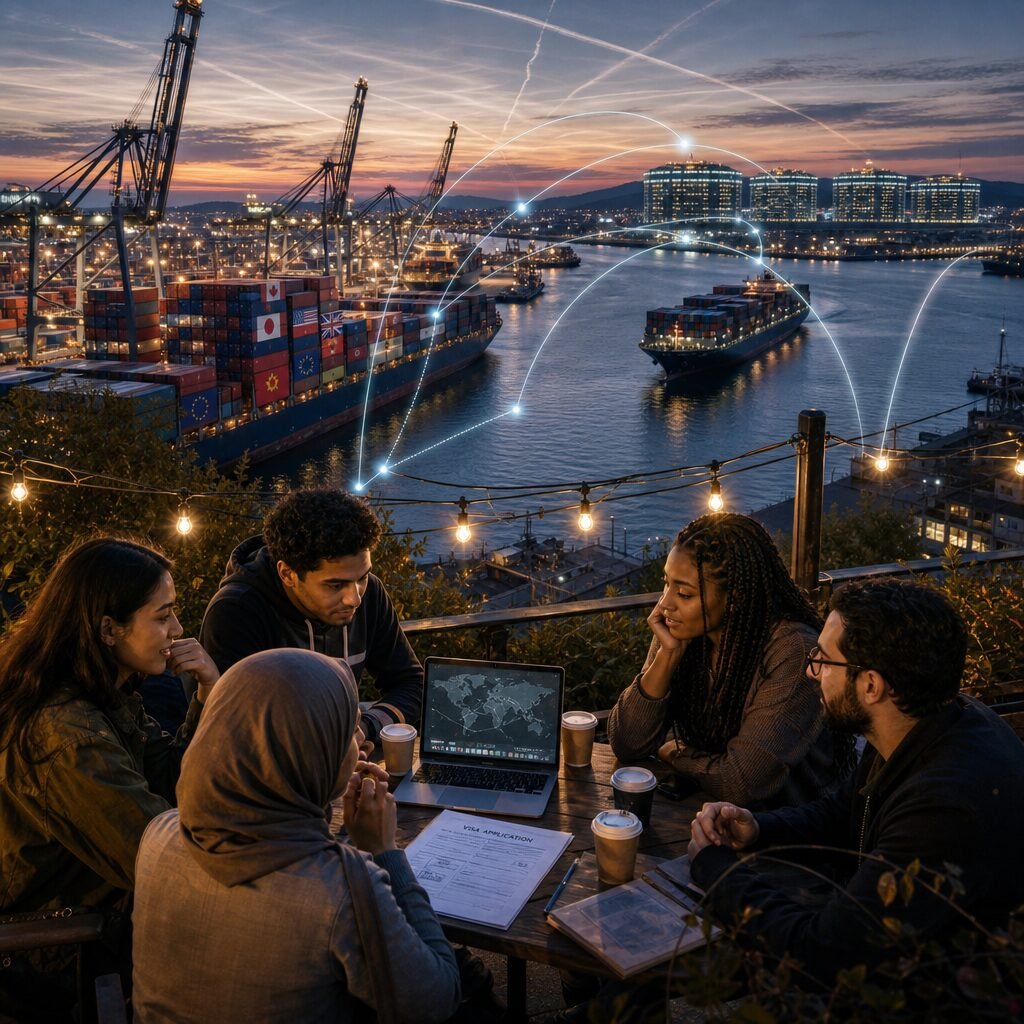
A Quiet Network: Why ‘International’ Is No Longer a Luxury
We celebrate borders when they fail spectacularly — a refugee crisis, a trade war, a pandemic — but we rarely stop to consider how the international actually underpins the ordinary. The word ‘international’ conjures summits and treaties, but in 2026 it is more akin to plumbing: invisible, taken for granted, and essential. This section reframes the international not as an occasional headline but as the constant scaffolding of daily life.
From the coffee in your cup to the code on your phone, multinational linkages and cross-border rules make modern routines possible. International matters because it organises scarcity and abundance across countries. It channels energy, labour and ideas. It standardises units of time, safety tests, data protocols and dispute mechanisms so that strangers in different hemispheres can transact with trust. When those scaffolds shift, lives change — slowly enough to be ignored until a fracture becomes a crisis.
The Invisible Currencies: Standards, Protocols and Trust
Currency and diplomacy are obvious international artefacts, but the more decisive currencies today are invisible: standards, protocols and trust frameworks.
Consider a mobile call routed through a dozen countries in a matter of seconds. That call works because telecom standards, undersea cables, and cross-border agreements exist and are maintained by international bodies, private consortia and cascading national regulations. Likewise, food safety standards let a mango from Kenya be sold in Manchester; intellectual property treaties let a Finnish design studio licence its work globally. Those are not mere conveniences — they are enforceable bridges that reduce transaction costs and enable complexity.
The recent roll-out of interoperable digital ID and payments systems across regions shows how these invisible currencies accelerate inclusion. Conversely, when standards fracture — whether due to geopolitical rivalry or protectionism — economic and social fragmentation follows. The lesson: international standardisation is a quiet yet potent engine of modern prosperity.
Microdecisions, Macroimpact: How Small Acts Become Global Forces
Not every international effect comes from diplomats or corporations; many arise from microdecisions made by individuals and small organisations whose actions ripple outward.
A start-up choosing to host its servers in Dublin, a university department switching to a common citation format, an NGO aligning its monitoring metrics with UN targets — each is a seemingly small international choice that shapes networks of compatibility and influence. Multiply these microdecisions and you get path dependencies: technological ecosystems, research paradigms and policy pipelines that favour certain values and actors.
This explains why initiatives that target the ‘plumbing’ — open-source platforms, regional research grants, visa microreforms — can produce outsized returns. They steer the direction of interoperability rather than merely reacting to it.
Supply Chains as Societies: The Human Geography of Things
Supply chains are commonly discussed in economic terms, but they are, in effect, transnational societies. A smartphone is the product of design in California, minerals from the Congo, assembly in Vietnam, software contributors spread worldwide, and logistics hubs across Europe.
Each node is governed by a mix of local labour laws, international trade rules and corporate standards. When a factory closure in one country ripples to inflation in another and to political unrest in a third, the connections are not abstract; they are human consequences of an international arrangement. Understanding ‘international’ therefore requires mapping social relations embedded in material flows.
Policymakers increasingly recognise this: resilience strategies now focus on diversification, nearshoring and redundancy. But these remedies carry their own international consequences — winners and losers, new corridors of dependency, altered labour markets — underscoring the moral stakes of managing global interconnectedness.
Culture, Memory and Conflict Prevention: The Soft Architecture
International institutions and agreements do hard things — adjudicate, fund, regulate — but their soft functions matter equally. Cultural exchange programmes, academic collaborations, multilateral disaster drills and joint scientific facilities create shared memories and professional communities that can de-escalate conflict.
Trust built over years of ordinary collaboration — joint observatories, student exchange alumni and cross-border civic networks — is the reserve currency of peace. It is easy to dismiss such soft architecture as sentimental; yet history shows that when hard institutions weaken, these social ties often provide the breathing space necessary to rebuild formal diplomacy. Investing in the soft side of internationalism is therefore a pragmatic strategy for risk reduction.
What to Do Now: Small Shifts with Lasting Effects
If international structures are the scaffolding of modern life, then repair and reinforcement needn’t be grand gestures. Practical interventions can magnify positive effects:
– Prioritise interoperability in digital policy, not national exclusivity, to preserve global innovation networks.
– Fund regional educational and research consortia that create shared professional norms.
– Map supply-chain social geographies to identify human vulnerabilities, not just economic bottlenecks.
– Support standards bodies and multilateral institutions that manage technical cooperation quietly but effectively.
These steps accept that complete sovereignty is a fiction in a connected world. The question is not whether international matters — it does — but whether we will deliberately shape the architecture that shapes us.