
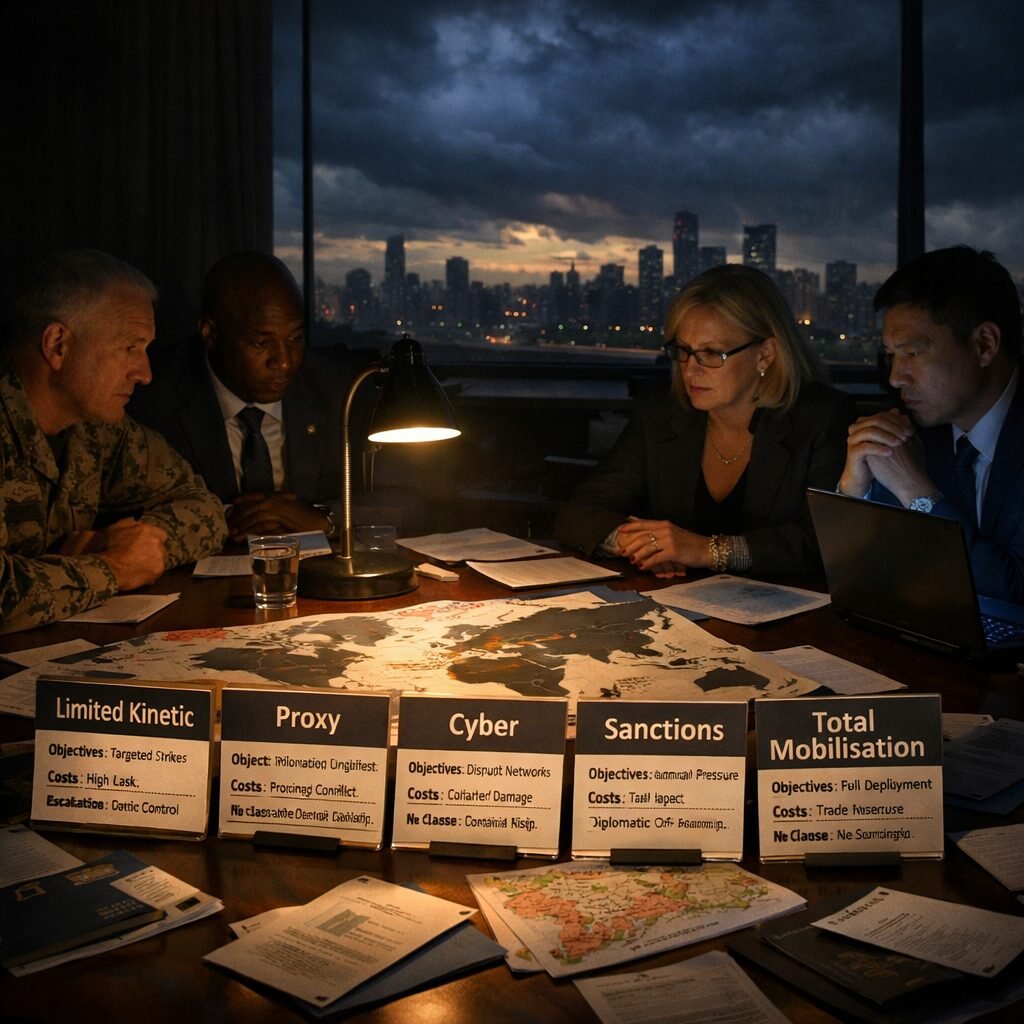
Preface: The Strange Marketplace of War
Imagine a catalogue where each page describes a conflict as if it were a product: features, warranty, side effects, and user reviews. The macabre thought experiment reveals an uncomfortable truth—states, coalitions and non-state actors already shop for wars. They evaluate objectives, costs, political constraints and international reactions before committing resources. Treating war as a decision to be chosen responsibly, rather than an inevitable eruption, forces a clearer ethical and strategic conversation.
This piece is not a how-to guide to violence. It is a journalistic inquiry into the decision architecture that leads to different kinds of war, written to give readers fresh categories and frameworks. By reframing war selection as a set of deliberate choices—each with trade-offs, thresholds and probable outcomes—we can see why some conflicts escalate and others fizzle, why some achieve stated aims and why many fail to do so.
Assess Your Needs: Goals, Constraints and the Moral Budget
The first, most neglected step is to define the need that violence is allegedly meant to satisfy. Is the aim territorial control, regime change, deterrence, economic gain, or signalling to a domestic audience? Precision here matters. Vague goals produce open-ended wars.
Next, inventory constraints. Political systems, geography, force posture, technological capabilities and international law limit choices. Democracies face different domestic tolerance levels than autocracies; island states confront different logistics to continental powers. Equally crucial is the ‘moral budget’—the maximum acceptable civilian harm, legal risk and reputational cost a polity is willing to bear. That budget is rarely stated but determines which forms of conflict are conceivable.
Match Types of War to Strategic Needs
Once needs and constraints are clear, different war types become more or less suitable. Below are categories often omitted from public debate but essential for a considered choice.
Limited kinetic conflicts: Short, targeted uses of conventional forces aimed at discrete objectives—seizing a border post, destroying a military depot, degrading an airbase. They are attractive when objectives are narrow and measurable, but they require precise intelligence and a credible exit plan.
Total war: Mobilisation of society and economy for overwhelming victory. Historically rare in the post-1945 era, total war can achieve decisive outcomes but destroys the moral budget and invites long-term instability.
Proxy war: Using local partners to fight on your behalf. Proxy options minimise direct casualties for the sponsor and can provide plausible deniability. They carry risks of loss of control, blowback and moral hazards when proxies commit abuses.
Cyber and information campaigns: Low-visibility, often below the threshold of kinetic response. Cyber tools can achieve disruption at lower immediate human cost, but attribution problems, escalation risks and fragile strategic effects complicate their utility.
Economic warfare and sanctions: These are coercive measures that can be calibrated to target elites or broader populations. They may avoid immediate violence but can produce long-term humanitarian and geopolitical consequences.
Hybrid approaches: Most contemporary conflicts are mixtures—cyber attacks to degrade communications, proxies to hold territory, sanctions to choke resources. Matching a hybrid design to the defined need is a complex optimisation problem with interacting variables.
Designing the Campaign: Instruments, Allies and Exit Strategies
Choosing a type of war is only the start. The campaign design translates selection into execution. Instruments—airpower, special forces, economic measures, information operations—must be chosen to fit the selected conflict type and the political constraints noted earlier. Each instrument has a tempo, visibility and collateral risk profile.
Alliances and coalitions alter the decision calculus. They expand capabilities and spread risk, but they also introduce coordination costs and political strings. A coalition can legitimise action internationally, but it often complicates objectives and timelines.
Exit strategy is the most misunderstood element. A credible, rehearsed, and communicated exit condition reduces mission creep. Exit strategies should spell out end-states, timelines, thresholds for escalation and post-conflict responsibilities. Without them, even limited wars calcify into chronic instability.
Aftercare: Reconstruction, Narrative and Legal Reckoning
Choosing a war implies accepting responsibility for the aftermath. Reconstruction, governance, and reconciliation are not optional add-ons; they determine whether an objective is durable. Winning a battle without winning the peace is a common blind spot.
Narrative management—how a conflict is framed domestically and internationally—matters for legitimacy. Post-war narratives shape recruitment, insurgency potential and future alliances. Democracies that fail to tell coherent stories about why they went to war risk rapid erosion of public support.
Legal and moral reckoning cannot be ignored. Compliance with the laws of armed conflict, transparent investigations of wrongdoing and mechanisms for victim redress influence long-term reputational costs and the ability to form alliances. The International Committee of the Red Cross provides guidelines on conduct in war; see Geneva Conventions for the legal framework that should inform any serious decision to resort to force.