
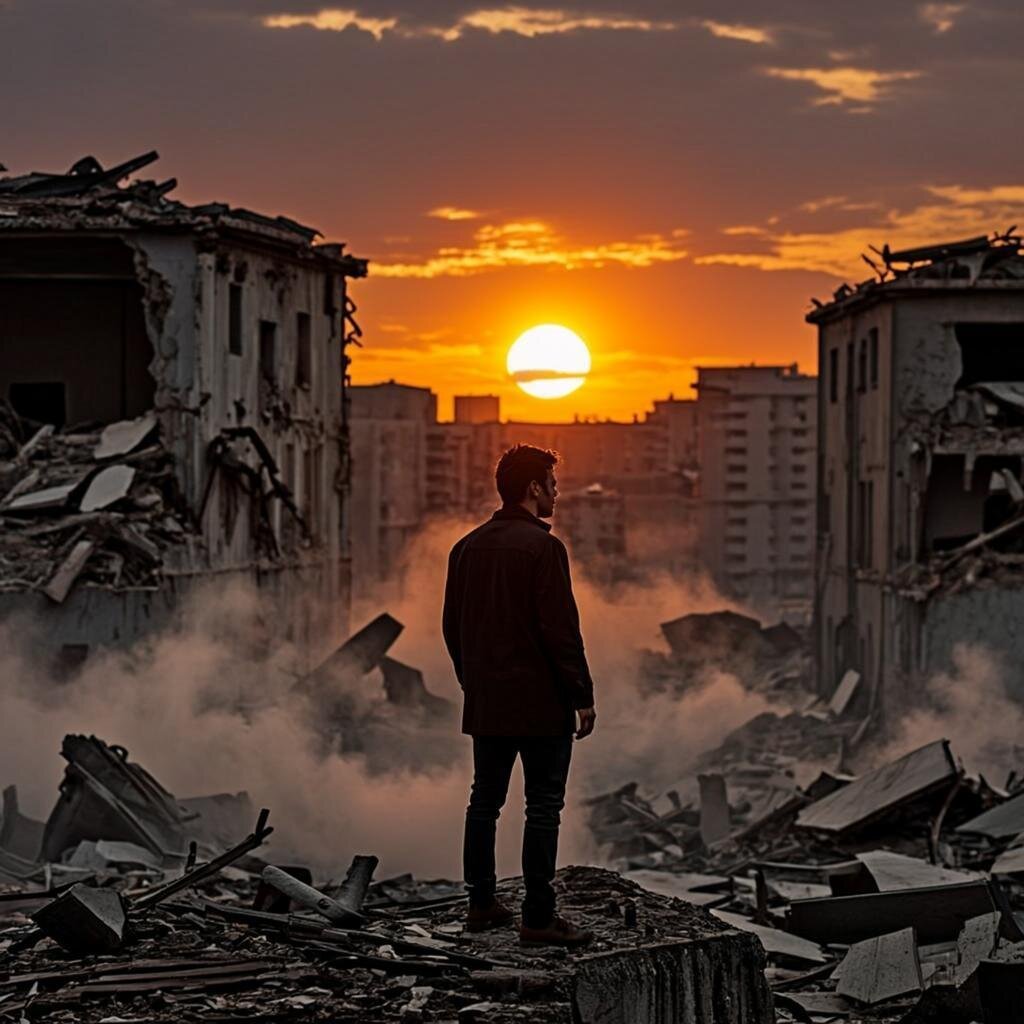
The Stranger Who Lives Inside Us
In 2018, a former British Army captain named Leo Docherty stood before a group of sociology students at the University of Exeter and said something that unsettled the room. ‘I miss it,’ he told them, speaking of his deployment in Helmand Province. ‘Not the violence. Not the death. But the… clarity. The feeling that every single moment mattered. Nothing in civilian life has come close.’
His confession is not unusual among veterans, but it points to something far more universal than military experience. The uncomfortable truth is that war exerts a gravitational pull on the human psyche that transcends politics, culture, and era. We are, in some fundamental sense, drawn to it.
This attraction operates beneath the level of conscious thought. It surfaces in the way crowds gather around violent incidents, in the morbid curiosity that drives millions to watch combat footage online, in the strange nostalgia some veterans feel for the worst experiences of their lives. It emerges in the language we use—’war on drugs’, ‘war on cancer’—as though conflict were not merely a tool but a framework for making sense of the world.
Psychologists and anthropologists have spent decades attempting to understand this phenomenon. What they’ve found suggests that our relationship with war is not simply one of horror and aversion, but something far more complex and troubling.
The Evolutionary Echo
To understand why war feels compelling, we must first recognise that the human brain evolved in conditions where violence was not aberrant but routine. For approximately 95% of human history, we lived in small nomadic bands where intergroup conflict was a leading cause of death. The anthropologist Lawrence Keeley has demonstrated that warfare among pre-state societies was both common and lethally efficient, with casualty rates that would make modern generals blanch.
In this environment, the capacity for violence—and the psychological mechanisms to engage in it without collapsing—was not a defect but a survival advantage. Evolution favoured those who could fight when necessary, bond tightly with their group, and process the trauma of killing without becoming incapacitated.
The result is a brain that contains, largely dormant, the neural architecture of the warrior. Dr Richard Wrangham of Harvard University has argued that humans possess what he calls ‘reactive aggression’ circuits that can be activated under specific conditions—when the group is threatened, when resources are scarce, when status is contested. These circuits do not disappear simply because we now live in nuclear-armed nation-states. They wait.
But evolution also equipped us with something else: a powerful aversion to killing our own kind. Lieutenant Colonel Dave Grossman’s research has shown that throughout military history, the majority of soldiers have been reluctant to fire their weapons at the enemy. This tension—between the capacity for violence and the resistance to it—creates a psychological landscape where war is simultaneously repulsive and magnetic.
The Chemistry of Combat
When Leo Docherty spoke of ‘clarity’, he was describing something neurochemically real. Combat triggers a cascade of neurotransmitters and hormones that fundamentally alter consciousness. Adrenaline sharpens perception. Dopamine creates a sense of intense reward. Endorphins numb pain and produce euphoria. Cortisol mobilises energy and suppresses non-essential functions, including the parts of the brain responsible for moral doubt and existential anxiety.
This neurochemical cocktail produces what veterans often describe as the most alive they have ever felt. Time slows. Irrelevance falls away. The mind, unburdened by the thousand petty concerns of civilian life, focuses with terrible precision on the immediate present.
Psychiatrist Jonathan Shay, who spent decades working with Vietnam veterans, noted that many of his patients struggled not with the trauma of what they had seen, but with the loss of this state. ‘They come back to a world that feels thin,’ he wrote, ‘where nothing seems to matter as much as it did when lives were on the line.’
This is not simply an addiction to adrenaline, though that plays a role. It is something more existential. The neurochemistry of combat mimics, in extreme form, the conditions that philosophers and mystics have sought for millennia: total presence, complete absorption in the moment, freedom from the self and its endless preoccupations. War offers this experience without requiring years of meditation or spiritual discipline. It is, as one veteran told me, ‘enlightenment with a body count.’
The Meaning Machine
Perhaps the most powerful draw of war is not chemical but narrative. Humans are meaning-making creatures, and few contexts generate meaning as intensely as conflict. War provides what the philosopher Roy Baumeister calls the four needs of meaning: purpose, value, efficacy, and self-worth.
In war, purpose is absolute—survival, victory, the protection of one’s comrades. Values are clarified—loyalty, courage, sacrifice become not abstract virtues but daily necessities. Efficacy is immediate—actions have visible, often life-or-death consequences. And self-worth is tested and proven in the most demanding circumstances imaginable.
The psychologist Rollo May argued that modern life, with its relative safety and comfort, creates a crisis of meaning that many find unbearable. ‘The values of efficiency, practicality, and conformity,’ he wrote, ‘do not give a person something to live for.’ War, by contrast, offers meaning in its most concentrated form. It tells you exactly who you are, what matters, and what you must do.
This explains why war has always been intertwined with the sacred. From Homer’s Iliad to modern propaganda, conflict is framed not merely as necessary but as ennobling—a crucible in which ordinary people become heroes. The reality, of course, is far grimmer, but the narrative persists because it answers a deep psychological need. We are drawn to war partly because we are desperate for the meaning it seems to provide.
The Brotherhood Illusion
Ask almost any veteran what they miss most about military service, and the answer is rarely the action. It is the people. The bonds formed in combat are, by all accounts, unlike anything available in civilian life. Soldiers describe a sense of connection so complete that they would, without hesitation, die for their comrades—and believe their comrades would do the same.
This experience is not accidental. Evolutionary psychologists have identified what they call the ‘band of brothers’ effect: the intense bonding that occurs when a small group faces a common threat. This bonding is mediated by oxytocin, the same hormone involved in maternal attachment and romantic love, but released in a context of shared danger and purpose.
The result is a sense of belonging that many find addictive. In a society where loneliness has reached epidemic proportions, where community bonds have frayed and social trust has eroded, the prospect of such connection exerts a powerful pull. Young men (and increasingly women) join the military not because they want to fight, but because they want to belong to something larger than themselves. War, in this sense, is the price of admission to a form of intimacy that civilian life rarely offers.
But this too is an illusion—or at least a partial one. The bonds of combat are real, but they are forged in conditions that are ultimately unsustainable. When the war ends, the community disperses, and veterans are left with memories of a connection they cannot recreate. Many spend the rest of their lives searching for it.
Breaking the Spell
If war draws us in because it satisfies deep psychological needs—for meaning, for connection, for intensity—then the obvious question is whether those needs can be met in other ways. The answer, tentatively, is yes—but it requires a fundamental shift in how we understand the problem.
Traditional approaches to peace and conflict resolution focus on rational persuasion: demonstrating that war is costly, destructive, and counterproductive. This approach assumes that people choose war based on a cost-benefit analysis, and that if the costs are made clear, they will choose differently. But if the attraction to war is psychological rather than rational—if it stems from needs that are not being met in peacetime—then this approach will always be insufficient.
What is needed instead is what the psychologist Paul Gilbert calls ‘compassion-based alternatives’: social structures that provide the meaning, connection, and intensity that war offers, without the destruction. This might include national service programmes that combine real challenge with community purpose. It might involve ritual and ceremony that mark transitions and create belonging. It might mean redesigning our institutions to give people more agency, more consequence, more skin in the game.
The anthropologist Margaret Mead once argued that warfare is not a biological imperative but a cultural invention—one that can, with sufficient effort, be replaced. If she is right, then the task is not to suppress our attraction to war but to understand it well enough to redirect it. The pull we feel toward conflict is not evidence of our depravity but of our hunger for lives that matter. The question is whether we can find ways to feed that hunger without feeding each other to the machine.