
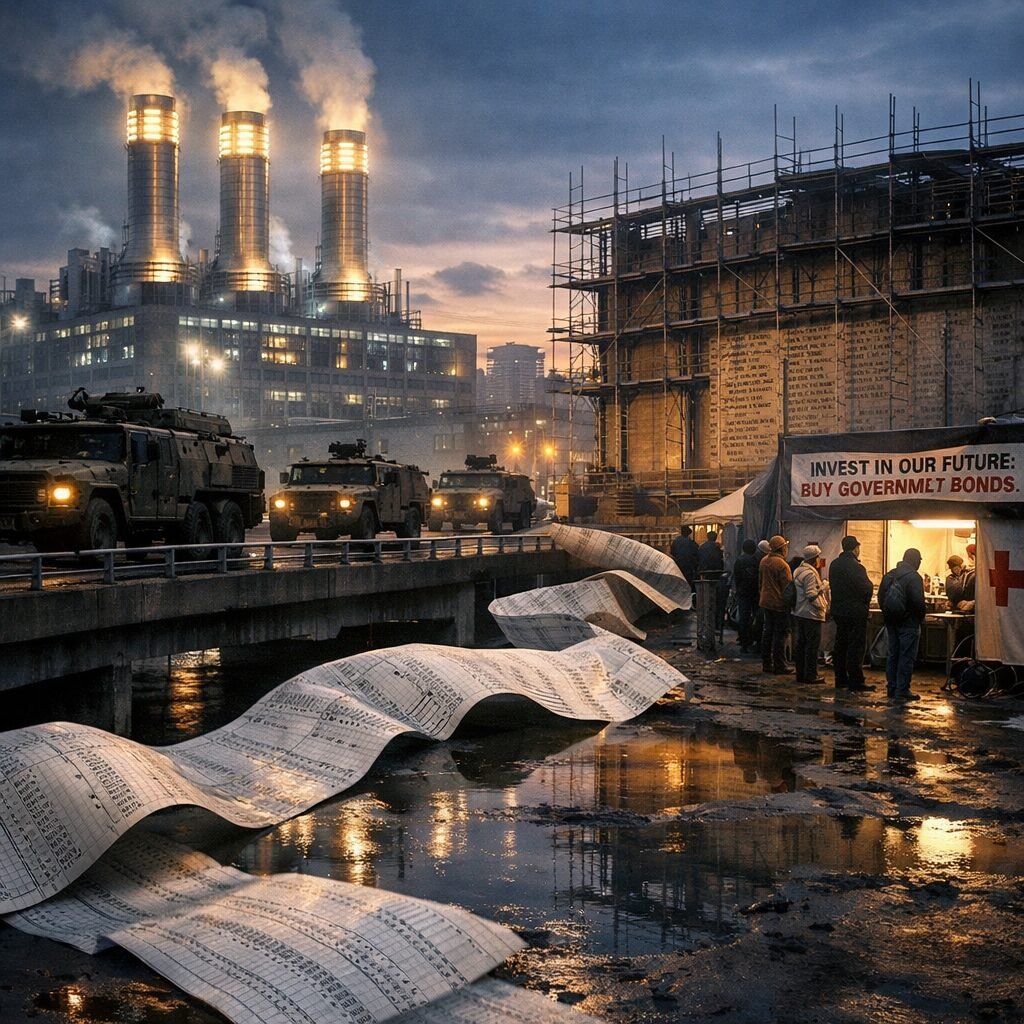
A Taxonomy of Return: Rethinking War as an Investment
When politicians and generals talk about war, they rarely use the language of finance. Yet across centuries the calculus of armed conflict has been haunted by return-on-investment logic: territory, resources, strategic depth, ideological dominance. This section reframes war not as chaos alone but as a set of predictable cash flows and asset transfers — some immediate, many deferred.
The initial outlay is obvious: mobilisation, ordnance, logistics. But wars also create streams of income or cost avoidance. Occupied economies can be taxed or looted; industrial capacity can be repurposed into war production that later yields peacetime markets; geopolitically secure routes lower future trade costs. An important distinction emerges between returns realised by states (tax revenue, territorial gain), private actors (contracts, patents), and abstract beneficiaries (ideologies that reshape institutions).
The Industrial Conversion: From Shells to Smartphones
Wars force rapid technological change and large-scale industrial conversion. Think of radar, jet engines, nuclear energy and the internet: many innovations that underpin modern prosperity were accelerated by military funding and demand. That acceleration is a measurable economic return, as new industries spin out of military R&D and soldiers-turned-engineers seed civilian firms.
Yet the return is uneven. Military-led innovation often creates path dependence — dual-use technologies lock economies into certain design logics and supply chains that favour incumbents. Corporations with pre-existing ties to defence ministries capture outsized rents, turning wartime orders into long-run market power. The civilian benefits may be real, but they are filtered through contracts, procurement rules and intellectual-property regimes that shape who actually profits.
Financial Alchemy: Debt, Bonds and the Inflation Tax
States rarely pay for wars with balanced budgets. They borrow, print or reallocate. Each choice carries different distributional effects — and long-term returns for different actors.
Borrowing externalises costs to future taxpayers. War bonds temporarily mobilise domestic savings and create a patriotic narrative; when bonds are repaid with inflated currency, governments effectively levy an ‘inflation tax’ on bondholders and wage earners. Monetisation of debt transfers resources to the state in the short run while eroding real liabilities over time. Private lenders, financial intermediaries and central banks can profit through fees, spread income and the privileged status of state paper.
In this sense wars can ‘pay for themselves’ for governments that control monetary outcomes: inflation lowers the real burden of debt, and growth stimulated by reconstruction can broaden the tax base. But those are returns to the state apparatus, not to those whose lives and capital were destroyed.
The Hidden Balance Sheet: Human Capital and Demographic Returns
Economic accounting that seeks an ROI on war must confront human capital effects. Loss of life, trauma, disrupted education and workforce displacement are immense and often permanent drains on productivity. At the same time, post-war societies sometimes experience demographic rebounds, accelerated female labour-force participation, or technological catch-up that partially offset those losses.
These demographic and social shifts have distributional consequences. Veterans compress medical and pension costs into public liabilities, while families of deceased workers suffer lifetime income loss. Private insurers, healthcare providers and pension fund managers may find new revenue streams in the aftermath. Thus human losses become budget lines, creating markets for care and compensation that transform sorrow into steady institutional cash flows.
Contractors, Capture and the Privatisation of War Profits
The modern war economy is heavy with private actors: defence firms, logistics companies, intelligence contractors and private military companies. Wartime spending pumps revenues into these firms and often establishes long-term government dependence. A major facet of how war ‘pays for itself’ is the political economy of procurement: sustained defence budgets, retrofit contracts and security subsidies become predictable income for a handful of firms.
Lobbying and revolving doors ensure that wartime winners can lock in post-war demand — through export licences, foreign training programmes or security guarantees. The beneficiary firms assetise expertise, patents and market access, turning fleeting conflict into durable business models. Shareholders, executives and sometimes host-state suppliers capture those returns, creating concentrated gains even as costs are socialised.
Geopolitics as Rent: Strategic Gains, Markets and Natural Resources
Territorial conquest and influence can yield direct economic returns: control of ports, pipelines, mines or trade corridors translates into resource rents. Occupation economies are often reorganised so that key sectors are dominated by the victor’s firms. Furthermore, geopolitical security lowers uncertainty for investors and can create favourable regimes for multinational capital.
But extracting those rents requires administrative capacity and often provokes resistance that undermines long-term returns. The calculus of occupation therefore blends expected resource income with counterinsurgency costs; the apparent ROI looks far better on balance sheets that ignore insurgent resistance, sanctions, or reputational damage that limits market access elsewhere.
Accounting for the Unaccountable: Reparations, Reconstruction and Memory
Post-conflict reconstruction is itself a market. Donor funds, rebuilding contracts and asset restitution create profit opportunities. Yet reconstruction also offers scope for corruption, misallocation and the persistence of extractive institutions. How a post-war economy is rebuilt determines whether the conflict generated net public benefit or entrenched rentier structures.
Reparations and legal judgments can reallocate resources, but they are rare and often partial. Memory and narrative — the politics of who is seen as victim or victor — shape future policy and therefore future returns. Nations that institutionalise veterans’ welfare, memorialisation, or strategic alliances may convert sacrifice into durable political capital; others see war debts and trauma transmit across generations.
Conclusion: The Moral Rate of Return
Viewed through ledgers and market flows, war can produce identifiable returns for states, firms and some social groups. But the notion that war ‘pays for itself’ depends entirely on which ledger you consult. Financial alchemy can hide distributional shifts; technological bloom can be accompanied by social scarring; territorial gains can be offset by long-term instability.
If there is an actionable insight, it is this: the economic returns of war are real but highly concentrated and conditional. Democracies that debate the true costs must expand their balance sheets to include human capital, institutional health and intergenerational liabilities — otherwise the apparent ROI will be a narrative that benefits a few and burdens many.