
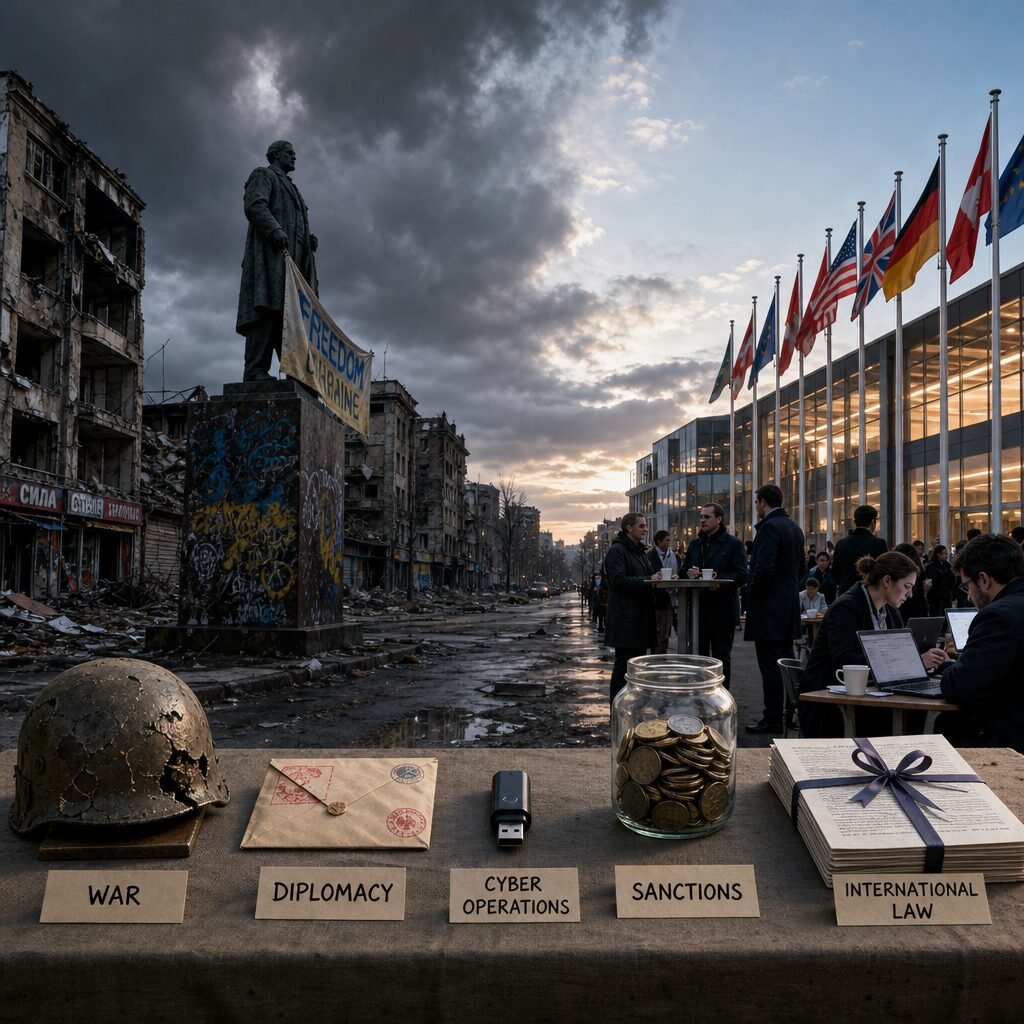
War as a Market Entrant: The Business Model of Violence
Treating war as if it were a competitor in a marketplace yields uncomfortable clarity. Like any firm, war offers a product: rapid territorial change, decisive regime removal, or intimidating signalling. Its selling points are speed, clarity and the theatricality of visible dashboards—tanks, flags, headlines. Its costs, paid by civilians, economies and ecosystems, are externalities few providers account for.
But war’s market share is shrinking. New entrants—sanctions, cyber operations, legal adjudication, economic statecraft, information operations—promise lower immediate human cost, greater deniability and better political palatability. Each alternative advertises a different value proposition: sanctions claim sustained pressure without bullets; cyber offers precision with plausible deniability; diplomacy trades immediacy for durability. The comparison forces a reframing: states choose instruments not only by utility but by brand, risk appetite and domestic marketing needs.
Speed versus Sustainability: The Product Lifecycle
War is a rapid-release product—effective quickly, often unsustainable in the long term. Its lifecycle includes intense initial effects followed by long tails of reconstruction, displacement and grievance. Alternatives behave differently. Diplomacy is slow-burn, requiring investment before yields appear; sanctions are subscription models that degrade opponents over months or years; cyber tools resemble micro-updates—frequent, targeted, often reversible.
This lifecycle difference shapes political calculus. Leaders seeking immediate electoral or strategic advantages may favour war’s immediacy despite future liabilities. Conversely, democracies with longer planning horizons may prefer subscription-style tools. Understanding these temporal profiles explains why, despite the proliferation of alternatives, war remains on the menu: its instant impact still meets certain political appetites more directly than patient instruments.
Risk, Attribution and Credibility: The Trust Economies of Coercion
Competitors to war sell reduced risk—especially reputational and legal risk. Sanctions operate in visible, institutional frameworks (think UN Security Council or regional blocs), offering a veneer of legitimacy. Cyber operations, by contrast, exploit ambiguity: attacks can be plausibly denied, allowing states to calibrate escalation without open confession.
That ambiguity cuts two ways. Denial reduces immediate consequence but erodes longer-term credibility if exposure occurs. Conversely, overt war is costly but unambiguously communicates resolve. In the governance of international relations, credibility is currency. States therefore select instruments not only for direct effect but for their signalling power in the trust economy of allies and rivals.
Collateral Markets: Economy, Innovation and the Spillover Effects
War’s competitors create different spillovers. Sanctions reshape trade routes, nurturing new suppliers; cyber conflict accelerates private-sector cybersecurity markets and surveillance industries; legal contests bolster international institutions and transnational NGOs. Some of these spillovers are constructive—new markets, regulatory harmonisation, technological innovation. Others replicate war’s destructive effects in subtler forms: supply-chain disruption that impoverishes civilians, digital authoritarianism that curtails rights.
Crucially, war remains a catalytic innovator. Military R&D has historically produced dual-use technologies; the internet itself has roots in defence funding. Thus, the line between competitive advantage and ethical cost is blurred: the alternatives often piggyback on the same catalytic dynamics war previously supplied, but with different distributional consequences.
Moral Markets: Legitimacy, Law and the Contest for Consent
Competition between war and its alternatives plays out in the moral marketplace. International law, human-rights advocacy and global public opinion are competing brands that reward non-violent means. When alternatives are perceived as lawful, they confer legitimacy on practitioners and delegitimise violent actors. Yet legality can be gamed: protracted economic coercion may be lawful but cruel, and legal victories sometimes produce hollow enforcement.
Consent matters. Occupation bought by force breeds resistance; negotiated settlements underpinned by local consent endure longer. Thus, beyond material effectiveness, instruments are evaluated by their capacity to secure consent and rebuild social contracts. The winner in this moral competition is often not the most destructive tool, but the one that can most plausibly claim a just, durable order.
Hybrid Competition: When Alternatives Become War’s Allies
Increasingly, the landscape resembles a blended market. States combine tools in ‘hybrid campaigns’: kinetic strikes paired with cyber sabotage, economic pressure with narrative operations. These hybrids exploit complementarity—cyber intrusions disable air defences before strikes; sanctions hollow out economies to make political control cheaper to assert; legal suits delegitimise opponents while covert action undermines their capacity to resist.
This convergence complicates simple comparisons. Alternatives are not pure substitutes; they are strategic complements that can make war more or less likely. Policymakers must therefore think in portfolios, weighing how a combination of tools alters incentives, costs and the probability of violent escalation.
Choosing Instruments: A Decision Framework
If war is one instrument among many, how should states choose? Effective decision-making requires three assessments: strategic clarity (are objectives achievable by the chosen tool?), escalation risk (will the tool provoke broader conflict?), and legitimacy calculus (will domestic and international audiences accept the method?).
Practical frameworks should incorporate second- and third-order effects: how will sanctions reshape global supply chains? Will cyber operations entrench surveillance norms? Could a punitive campaign create refugee flows that destabilise regions? Decisions that ignore these externalities mistake short-term efficiency for long-term prudence.
Conclusion: The Competition for Better Politics
Seen through the lens of competition, war loses some of its mystique as an inevitable instrument and becomes instead a strategic choice among many, each with different costs, timelines and moral footprints. The challenge for the international system is not merely to offer alternatives, but to align incentives so that less brutal, more sustainable instruments reliably beat violence in effectiveness, legitimacy and political reward.
That requires strengthening institutions, clarifying legal norms around new domains like cyber, investing in diplomatic capacity and making the political case for patience. Only then will the market tilt decisively away from war and towards instruments that solve problems without remaking societies in ruin.