
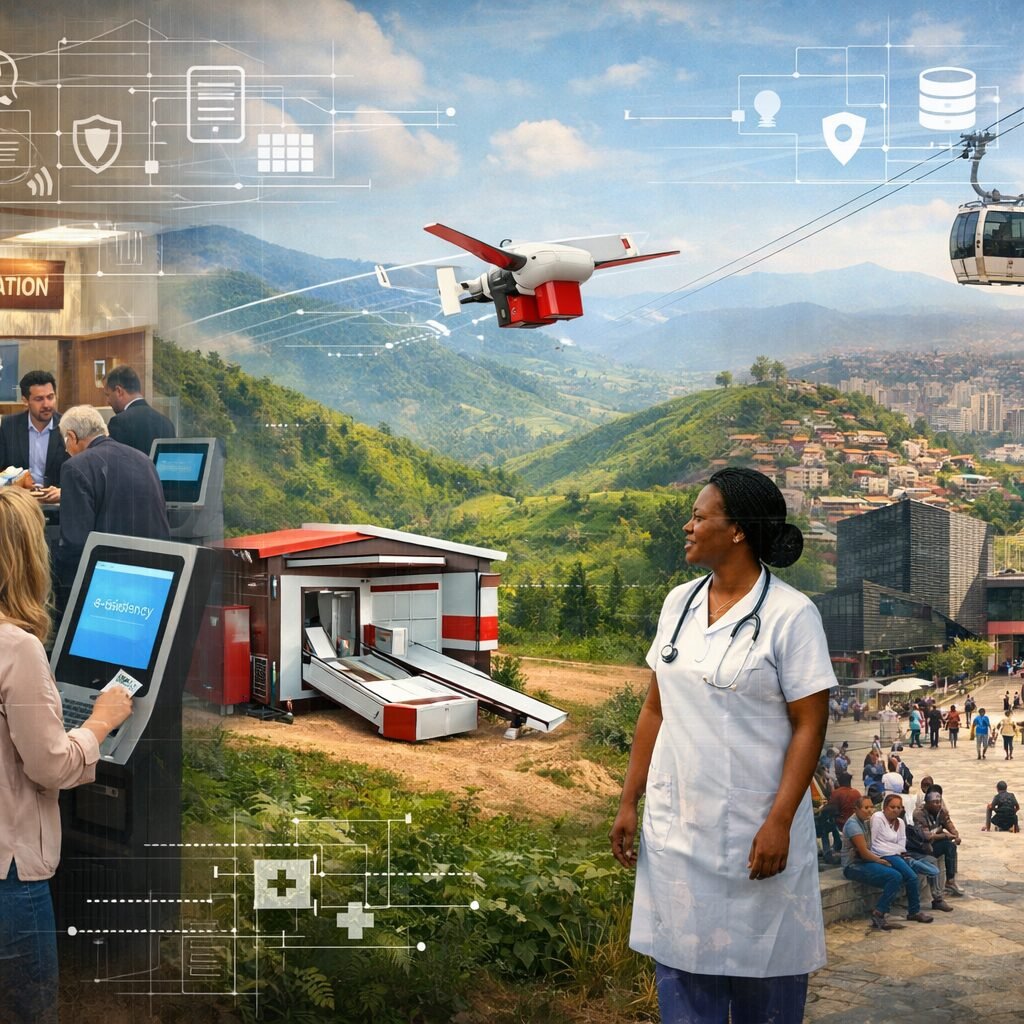
When ‘International’ Means Fast, Practical Change
International is often framed as diplomacy, trade agreements and headline-grabbing summits. But the most potent international stories are quieter: targeted transfers of technology, policy and practice that produce measurable improvement in people’s lives. This article collects real-world success stories where international exchange was less about grand rhetoric and more about pragmatic problem-solving — digital residency codes shared across borders, drones criss‑crossing rural valleys, and city officials swapping playbooks to solve urban crises. Each case shows how international flows can bypass bureaucratic inertia, shorten learning curves and scale solutions with surprising speed.
The value of these stories is twofold. First, they reveal mechanisms — legal sandboxes, public–private partnerships, adapted governance models — that made international approaches effective. Second, they offer a template for other places: the success often lies less in the technology itself than in the way it was embedded into local institutions. The sections that follow examine three distinct case studies and then extract transferable lessons for policymakers, civic leaders and business innovators.
Case Study: Estonia’s e‑Residency — exporting a digital civic toolbox
Estonia launched e‑Residency in 2014 as an audacious experiment: allow non‑citizens to access a digital identity issued by the state to run businesses remotely. It was never intended to be a mass immigration tool; it was an internationalisation of the administrative interface. Within a few years the programme attracted entrepreneurs from across the globe, enabling them to register EU‑based companies, sign documents and manage banking remotely.
The surprising success was not simply the tech stack (strong cryptographic identity and user‑centric portals) but Estonia’s willingness to export governance ideas. Several countries — from Lithuania to Ukraine — studied Estonia’s legislative scaffolding and adapted it to local needs. Estonia also partnered with private firms to create onboarding services, helping overseas users navigate regulatory and tax questions. The result: a new export for a small country and a playbook for how sovereign digital services can be offered internationally without physical migration.
Importantly, e‑Residency sparked debates about sovereignty, taxation and access that forced recipient countries to strengthen regulatory clarity. These political conversations, prompted by an international product, improved domestic transparency and regulatory capability — a civic spill‑over effect that many technology exports neglect to mention.
Case Study: Zipline and Rwanda — international logistics solved with drones
Rwanda’s adoption of autonomous drone delivery for blood and medical supplies began as a collaboration between the Rwandan government, US start‑up Zipline and international donors. What made it work was not just the aircraft but a lean, iterative operational model tailored to local geography and health systems. Instead of exporting a fixed product, Zipline and Rwandan health authorities co‑designed hubs, flight corridors and inventory protocols that aligned with clinic routines and emergency triage procedures.
Within months the service reduced delivery times for critical supplies from hours to minutes in remote districts, directly improving surgical outcomes and maternal health metrics. International partners provided funding and regulatory expertise; local teams provided practical constraints and clinical priorities. The initiative scaled to neighbouring countries by presenting a complete operational package — technical, regulatory and clinical — rather than a standalone gadget.
Crucially, Rwanda retained institutional learning: national aviation authorities upgraded drone regulations, and hospital procurement systems were modernised. Other countries adopted Zipline’s model only after seeing the whole system — governance, training, logistics — successfully implemented, demonstrating that international technology transfer succeeds when it includes the less glamorous but essential administrative work.
Case Study: Medellín’s urban renaissance through global exchanges
Medellín, Colombia, transformed an image of violence into a widely studied model of urban innovation, thanks in part to international exchanges. City leaders intentionally sought out counterparts from Barcelona, Bogotá and international foundations to import techniques: cable‑car public transit adapted to steep topography, integrated social urbanism projects that combined libraries, parks and healthcare, and participatory budgeting processes.
The international angle was unusual: Medellín actively borrowed not merely technologies but municipal practices — conflict mediation methods, community engagement frameworks and data‑informed policing strategies — then adapted them to local culture. Visiting delegations and sustained technical partnerships ensured knowledge was not a one‑off lecture but a sustained mentorship. The city’s success attracted further investment and created a virtuous cycle: international recognition brought funding, which funded more experimentation and local capacity building.
This case shows that international borrowing works best when treated as co‑development. Medellín did not mimic Barcelona wholesale; it used international models as scaffolding, iterating with local communities until solutions fit. That approach made the changes resilient and exported a new kind of global urban practice: learning networks rather than one‑way aid.
Common Threads: What made these international initiatives succeed
Across the cases certain patterns recur:
– System packages, not single products: International transfers that packaged technical, legal and operational elements scaled far better than isolated technologies. Recipients needed playbooks — not just hardware.
– Local adaptation and institutional ownership: Success required local actors to shape, own and embed the imported practice. That meant training, legal tweaks and cultural adaptation, not mere deployment.
– Iterative partnerships: Short pilot cycles, feedback loops and transparent data sharing allowed partners to refine solutions rapidly and build trust.
– Regulatory co‑creation: Early engagement with regulators avoided later legal bottlenecks. Countries that treated regulation as part of the exportable product moved faster.
– Visible social metrics: Projects that tracked and publicised social impact (health outcomes, time savings, crime reduction) attracted further international support and domestic buy‑in.
These elements together turn international exchange from performative diplomacy into practical transformation.
Practical Lessons for Policymakers and Innovators
If you are a policymaker, business leader or civic innovator looking to harness international collaboration, start by designing a minimum viable system: the technical core plus the legal template and a training module. Seek partners who will commit to iterative pilots rather than one‑off contracts. Prioritise local institutional capacity — budget for public servants’ training and create pathways for regulatory harmonisation.
For donors and investors, fund the administrative glue: budgets that pay for procurement reform, regulatory harmonisation and community outreach often achieve higher returns than those limited to hardware. And measure success in service outcomes, not installations.
Finally, treat international exchange as two‑way. The most interesting innovations — Estonia’s governance code, Zipline’s logistics model, Medellín’s participatory planning — became exportable precisely because they were proven, documented and adaptable. Make documentation a deliverable.
Conclusion: International as a multiplier of practical solutions
International exchange is no longer merely a platform for spectacle; it can be a multiplier of practical solutions when packaged, adapted and embedded. The real world success stories examined here show that the transformative power of international lies in its ability to move whole systems — law, operations, training and technology — across borders. Policymakers and innovators who focus on systems, not gadgets, will find that international collaboration accelerates learning and amplifies impact in ways traditional aid and diplomacy rarely achieve.